

Volatility trading is defined as the practice of profiting from changes in market price movement magnitude rather than predicting directional moves. That distinction matters. Volatility strategies allow returns independent of whether markets rise or fall, providing portfolio diversification through low correlation with traditional assets. The core tools include implied volatility (IV), realized volatility (RV), the volatility risk premium (VRP), and IV Rank. Traders who understand these concepts gain access to a category of edges that most directional traders never see. This article breaks down the volatility trading advantages, the techniques that unlock them, and the risk controls that keep you in the game.
1. What are the primary volatility trading advantages?
Volatility trading offers three structural benefits that directional trading cannot match: market neutrality, portfolio diversification, and hedging power.
Market neutrality means your trade profits from how much price moves, not which way. A long straddle on an index profits whether the market crashes or surges. That independence from direction removes one of the hardest forecasting problems in trading.

Portfolio diversification works because volatility strategies carry low correlation with traditional assets. Adding a volatility sleeve to a stock or bond portfolio reduces overall drawdowns without sacrificing return potential. This is the same logic institutional funds use when allocating to volatility as a standalone asset class.
Hedging against unknowns is the third benefit. Volatility strategies protect against events that no model predicts. Buying options before earnings, elections, or central bank meetings locks in defined risk while keeping upside open. The benefits of volatility trading compound when you combine all three: a market-neutral, diversifying, hedging-capable position set.
Key advantages at a glance:
- Profits in rising, falling, and sideways markets
- Reduces portfolio correlation to equities and bonds
- Provides tail protection against unexpected macro events
- Creates repeatable edges through structural pricing inefficiencies
- Works across crypto, forex, indices, commodities, and futures
2. How does the volatility risk premium work?
The volatility risk premium is the single most important structural edge in volatility trading. VRP is the consistent gap where implied volatility prices options above what realized volatility actually delivers.
VRP in US equity index options averages 4–6 percentage points above realized volatility over time. That spread widens to 8–10 points during calm markets and shrinks or turns negative during volatility spikes. Sellers of options systematically collect this premium by writing contracts that the market consistently overprices.
The catch is the return profile. Selling volatility premiums produces steady small gains interrupted by rare, large losses. The statistical term for this is negative skew. A trader can win 80% of months and still blow up if one spike wipes out a year of gains. Proper position sizing is what separates professionals from traders who learn this lesson the hard way.
VRP also varies by market regime. In low-volatility environments, the premium is fat and selling is attractive. During stress periods, implied volatility can spike faster than you can adjust, making the premium temporarily negative. Timing entries around regime shifts is what separates average VRP traders from consistent ones.
Pro Tip: Track VRP as a rolling 30-day spread between IV and realized volatility. When the spread exceeds its 12-month average, conditions favor premium selling. When it collapses, reduce size or step aside.
3. What techniques optimize volatility trading entries?
Entry timing in volatility trading relies on two primary metrics: IV Rank and the IV-to-historical-volatility (IV/HV) ratio. Both tell you whether options are currently cheap or expensive relative to their own history.
IV Rank measures current implied volatility against its 52-week range. A reading above 50% signals that options are expensive relative to recent history, favoring premium selling. A reading below 30% signals cheap options, favoring buying strategies or staying neutral. When IV Rank sits at the bottom decile, implied volatility rises roughly 32% over the following month. That mean reversion is the edge.
The IV/HV ratio adds a second layer. When IV runs significantly above historical volatility, the market is pricing in fear that may not materialize. Selling into that fear collects the gap. When IV runs below HV, the market is underpricing risk, and buying volatility makes sense.
Volatility mean reversion is the mechanical foundation of most volatility trading techniques. Volatility does not trend indefinitely. It spikes, then reverts. Traders who build entries around that reversion pattern gain a repeatable, data-driven edge that does not depend on predicting market direction.
Pro Tip: Use IV Rank as a binary filter before every trade. If your strategy sells premium, require IV Rank above 50% before entering. This single rule eliminates a large percentage of low-probability setups.
A practical entry framework:
| Condition | IV Rank | Preferred approach |
|---|---|---|
| Expensive options | Above 50% | Sell premium, short straddles, iron condors |
| Neutral zone | 30%–50% | Reduce size, wait for clearer signal |
| Cheap options | Below 30% | Buy volatility, long straddles, tail hedges |
Understanding volatility indicators like IV Rank and VIX term structure gives you the data layer that most retail traders skip entirely.
4. What are the risks in volatility trading?
Volatility trading carries a specific risk profile that differs sharply from directional trading. The danger is not gradual loss. It is sudden, large drawdowns that arrive with little warning.
Macro market crises demonstrate that liquidity dries up and risk models fail during volatility spikes. Short volatility trades that performed well for months can lose multiple years of gains in a single week. The 2018 "Volmageddon" event and the March 2020 COVID crash both produced exactly this pattern.
"The core risk in short volatility trading is not losing slowly. It is losing everything quickly. A trader who survives a volatility spike by managing size correctly will still be in the game when conditions normalize. One who does not will not get a second chance."
Portfolio vega exposure is the key risk metric. Many retail traders size positions by dollar notional or delta, which misses the point entirely. Vega measures how much your position gains or loses per one-point move in implied volatility. A position with high vega can suffer catastrophic losses in a spike even if the directional move is small.
Critical risk management practices:
- Size positions by vega, not notional value or delta
- Stress test every position for a 20-point IV expansion scenario
- Set hard stop-loss rules based on vega loss thresholds, not P&L alone
- Reduce exposure before known high-risk events like Fed meetings and earnings
- Use risk management frameworks that account for volatility regime shifts
Trading volatility risks are real and asymmetric. The upside is steady premium income. The downside is a tail event that ignores your stop orders and gaps through your levels. Respecting that asymmetry is not optional.
5. What workflow styles support successful volatility trading?
Systematic, automated volatility trading workflows reduce emotional errors and apply data-driven entry and exit decisions using Z-scores and regime classifications. Discretionary traders who "feel" their way into volatility positions consistently underperform rule-based systems over time.
Institutional volatility trading favors strict, quantifiable processes over intuition. The entry trigger is binary: either the VRP z-score exceeds the threshold or it does not. Either IV Rank clears 50% or it does not. There is no "close enough." That discipline removes the biggest source of retail trader failure, which is overriding the system when it feels uncomfortable.
A practical volatility trading workflow includes these daily steps:
- Screen for IV Rank readings above or below key thresholds across your watchlist
- Calculate the current VRP z-score to confirm premium is statistically elevated
- Check the VIX term structure for contango or backwardation signals
- Size the position by vega budget, not dollar amount
- Set entry, adjustment, and exit triggers before placing the trade
- Log every trade with the IV Rank and VRP reading at entry for review
Real-time volatility screeners rank implied volatility against historical ranges and flag rich or cheap options instantly. Without real-time data, you are reacting to yesterday's conditions. The role of volatility in scalping follows the same logic: systematic triggers beat discretionary calls every time the data is available.
Understanding market volatility fundamentals is the prerequisite for building any of these workflows correctly. Traders who skip that foundation tend to apply the right tools to the wrong market conditions.
Key Takeaways
Volatility trading advantages are most accessible to traders who combine structural edge identification, disciplined entry timing, and strict vega-based risk control.
| Point | Details |
|---|---|
| Market-neutral returns | Volatility strategies profit from movement magnitude, not direction, removing directional forecasting risk. |
| VRP as a structural edge | The volatility risk premium averages 4–6 points above realized volatility, creating a repeatable selling edge. |
| IV Rank for entry timing | Sell premium above IV Rank 50%; buy or stay neutral below 30% for statistically favorable entries. |
| Vega-based position sizing | Size every position by vega exposure, not notional value, to survive volatility spike scenarios. |
| Systematic workflows win | Binary pass/fail triggers using VRP z-scores and IV Rank thresholds outperform discretionary decisions. |
Why volatility trading rewards the disciplined trader
I have watched traders approach volatility with the same mindset they use for stock picking, and it almost always ends badly. The market does not care about your directional thesis when you are short a straddle and the VIX doubles overnight.
What I have found actually works is treating volatility as its own asset class with its own pricing logic. The implied versus realized volatility gap is not random noise. It is a structural inefficiency that exists because market participants consistently overpay for protection. Sellers who understand skew and term structure collect that overpayment systematically.
The traders I respect most in this space are not the ones with the best market calls. They are the ones who never let a single position threaten their account. They size by vega, stress test before entering, and exit when the signal says to exit, not when they feel ready. That combination of structural edge and iron discipline is what makes volatility trading worth it over the long run.
My one warning: do not start selling premium without first understanding what a volatility spike looks like on your P&L in real time. Paper trading a short straddle through a 15-point VIX expansion will teach you more than any article can.
— Tran
Scalping-algo's tools for volatility-focused traders
Volatility trading requires real-time signals, strict entry rules, and tools that do not lag behind the market. Scalping-algo builds exactly that for active traders.
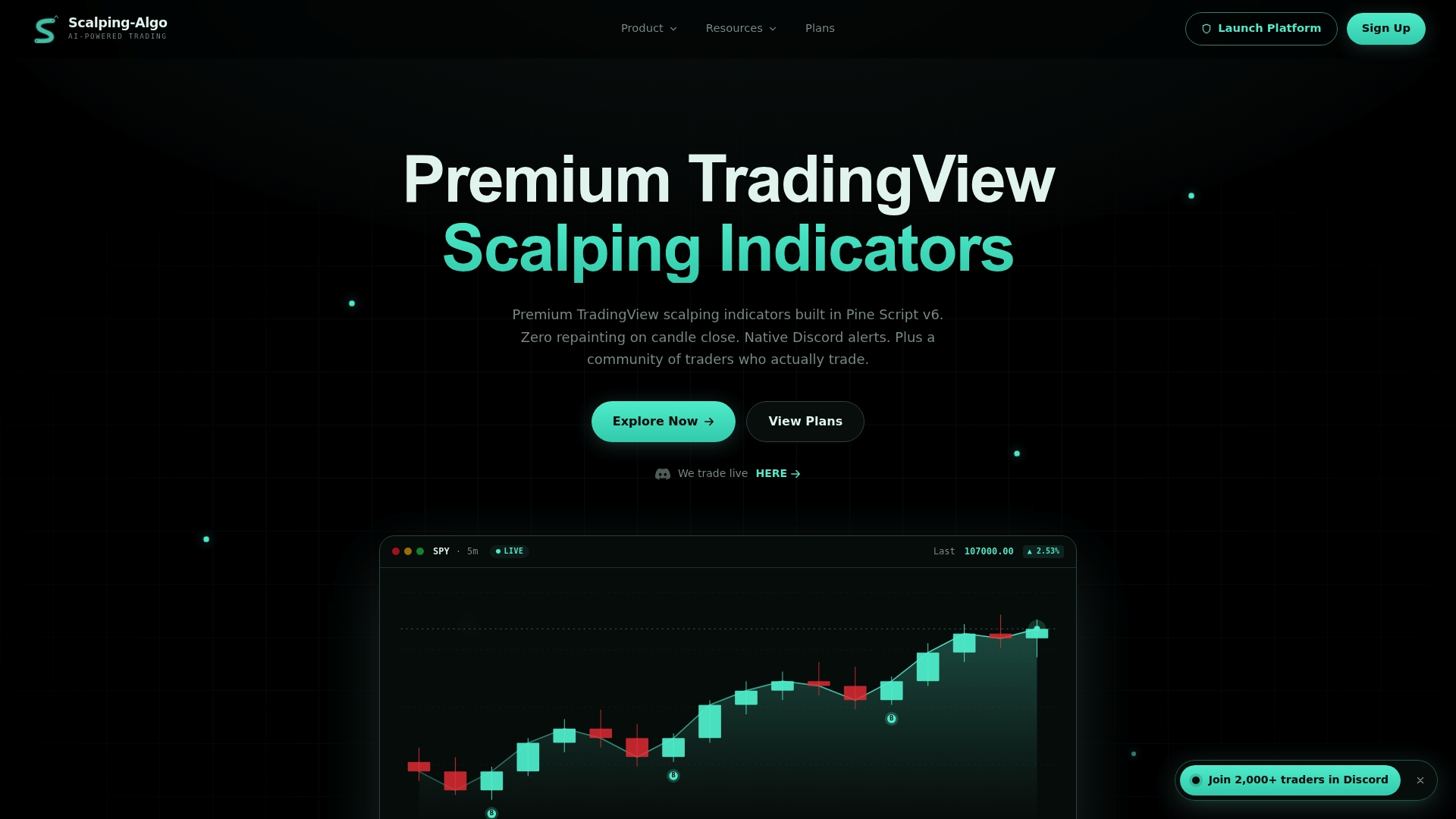
The Algo Master 3-indicator suite applies systematic, non-repainting buy and sell signals across crypto, forex, indices, and futures on timeframes from 1 minute to 15 minutes. Volatility gating filters out low-probability setups automatically, so you only see entries that meet the threshold. The full indicator platform includes confluence tools, divergence detection, and native webhook alerts to Discord for fast execution. If you want a workflow that runs on data instead of gut feel, Scalping-algo gives you the infrastructure to build it.
FAQ
What is volatility trading?
Volatility trading is the practice of profiting from changes in the magnitude of price movement rather than predicting market direction. Traders use instruments like options and volatility derivatives to capture the gap between implied and realized volatility.
Why trade volatility instead of directional strategies?
Volatility strategies generate returns independent of whether markets rise or fall, providing diversification and hedging benefits that directional trades cannot. The volatility risk premium creates a structural, repeatable edge for sellers over time.
What is IV Rank and why does it matter?
IV Rank measures current implied volatility as a percentile within its 52-week range. Readings above 50% favor premium selling; readings below 30% favor buying volatility, making it the primary entry filter for most volatility strategies.
How do traders manage risk in volatility trading?
Professional traders size positions by vega exposure rather than notional value and stress test every position for a sharp IV expansion scenario. Hard exit rules based on vega loss thresholds prevent a single spike from wiping out accumulated gains.
Is volatility trading worth it for retail traders?
Yes, when approached with systematic rules and proper position sizing. The volatility risk premium delivers consistent edges, but negative skew means rare large losses require strict risk controls to avoid catastrophic drawdowns.