

Trade execution is defined as the process of completing a buy or sell order in financial markets by matching it with a counterparty, turning your instruction into an actual transaction. Most retail traders focus on picking entries and exits, but the mechanics of how that order gets filled determine whether your strategy performs as planned or bleeds value on every trade. Understanding the trade execution process, order types, and quality factors gives you a real edge, not just theoretical knowledge.
What is trade execution and how does it work?
Trade execution begins the moment you submit an order through your broker's platform. You specify the security, the direction (buy or sell), the size, and any price instructions. From there, your broker's order management system validates the order, checks your account balance, and routes it toward a venue.
The full sequence looks like this:
- Order placement. You submit through a broker platform such as TD Ameritrade, Interactive Brokers, or a retail crypto exchange.
- Validation and checks. The broker's system confirms you have sufficient funds or margin and that the order parameters are valid.
- Order routing. The broker sends the order to an exchange, dark pool, or market maker depending on routing logic and venue selection.
- Matching engine. The venue's matching engine pairs your order against resting orders using price/time priority rules.
- Execution confirmation. Your broker receives a fill report and pushes a confirmation to your account.
- Trade record. The executed trade is logged with price, size, timestamp, and venue.
Retail investors see execution happen in milliseconds to microseconds in liquid markets. That speed is not automatic. It depends on the venue, the broker's routing infrastructure, and current market conditions. In thinly traded securities or during high-volatility events, that same process can slow down or produce unexpected fill prices.
Pro Tip: Always check your broker's order routing disclosure. Brokers are required by FINRA and the SEC to publish quarterly reports on execution quality. Reading these reports tells you whether your fills are consistently at or better than the National Best Bid and Offer (NBBO).

How order types affect your execution outcomes
Order type is the single biggest variable you control in the execution process. Each type makes a different tradeoff between speed, price certainty, and fill guarantee.
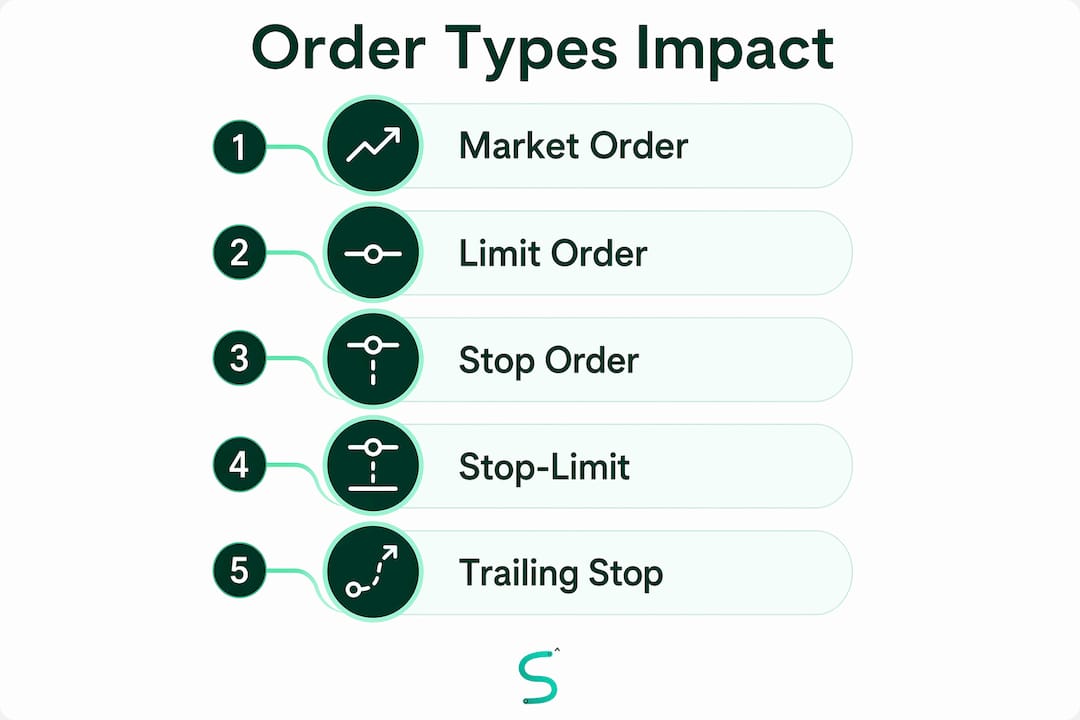
Market orders execute immediately at the best available price. Limit orders fill only at your specified price or better. Stop orders become market orders once a trigger price is hit, introducing conditional execution that can surprise traders during fast-moving markets.
| Order Type | Speed | Price Control | Fill Certainty | Best Used When |
|---|---|---|---|---|
| Market | Immediate | None | High | Liquid markets, urgent entries |
| Limit | Slower | Full | Moderate | Precise entries, less urgent trades |
| Stop | Conditional | None after trigger | Moderate | Risk management, breakout entries |
| Stop-Limit | Conditional | Full after trigger | Lower | Controlled stop with price floor |
Key points every retail trader should know about order types:
- Market orders in thin markets can "walk the book," meaning your order consumes multiple price levels and fills at a worse average price than the displayed quote.
- Limit orders protect your price but risk non-execution if the market never reaches your level.
- Stop orders are powerful for risk management but can trigger at prices far from your stop level during gaps or fast markets.
- Volatility matters. Execution quality varies with order type and market liquidity, which means a strategy that works cleanly in normal conditions can underperform during earnings releases or macro events.
Pro Tip: For scalping on lower timeframes, market orders are often necessary for speed. Pair them with tight position sizing to limit slippage exposure. Scalping-algo's volatility gating tools help identify when market conditions make limit orders a smarter choice.
What affects trade execution quality?
Execution quality is not just about getting filled. It measures how close your actual fill price is to the price you intended, how fast the fill occurred, and what it cost you in fees and slippage. Broker-dealers must use reasonable diligence to provide best execution, meaning the most favorable price under prevailing conditions, not just the best displayed quote.
The SEC's Regulation Best Execution framework defines quality across five dimensions: price, speed, certainty of execution, transaction cost, and order size. This means your broker is legally obligated to consider all five, not just route to the cheapest venue.
Factors that directly affect your fill quality:
- Order book depth. A deep order book absorbs large orders without moving price. Thin books cause slippage on even modest-sized trades.
- Venue selection. Order routing and venue choice heavily influence execution quality. Brokers consider price improvement, speed, and available liquidity at each venue.
- Market volatility. Retail traders should expect execution deviations especially during volatile or low-liquidity periods. The last traded price you see on screen is historical. Your fill is live.
- Time of day. The opening and closing 30 minutes of U.S. equity sessions carry the highest volume but also the widest spreads and fastest price movement.
- Broker infrastructure. Direct market access (DMA) brokers route orders faster and with less intermediary interference than payment-for-order-flow (PFOF) models.
"Best execution focuses on the overall quality of the transaction, not just the posted price, highlighting broker due diligence in routing and execution decisions." — SEC Regulation Best Execution
Understanding real-time market data is directly tied to execution quality. Stale data leads to orders placed at prices that no longer reflect reality, which is one of the most common and preventable causes of slippage for retail traders.
What happens after execution: clearing and settlement
Execution is not the end of the trade. It is the beginning of a two-step post-trade process: clearing and settlement. Many retail traders assume they own the shares or coins the moment their order fills. That assumption is wrong, and it can cause real problems with cash management.
Here is how the post-execution lifecycle works:
- Trade date (T). The order executes. Your broker records the trade and sends a confirmation.
- Clearing. The clearing house calculates net obligations between all counterparties. The Depository Trust Company (DTC) completes settlement of shares and cash on the settlement date.
- Settlement (T+1). Most securities settle the next business day after trade execution under the U.S. T+1 standard, which took effect in May 2024.
- Ownership transfer. Shares are credited to your account and cash is debited (or vice versa) only at settlement.
- Cash availability. Proceeds from a sale become fully available for withdrawal or reinvestment after settlement, not at execution.
The shift to T+1 in 2024 was a meaningful change for active retail traders. It shortened the window between execution and cash availability, which matters if you are managing a cash account or planning reinvestment timing. The T+1 settlement cycle requires traders to monitor settlement timing closely for reinvestment or margin purposes. Ignoring this can result in good-faith violations in cash accounts or unexpected margin calls.
How automated trade execution works for retail traders
Automated trade execution uses computer programs to generate and submit orders based on predefined rules, without manual intervention at the moment of the trade. This is what is commonly called algorithmic trading, and it is no longer exclusive to institutional desks.
Retail traders can configure algorithmic strategies with parameters controlling timing, routing, and order size to improve execution. The practical benefits for active and scalping-focused traders are significant:
- Speed. Algorithms react to signals in milliseconds, far faster than any manual click.
- Consistency. Rules-based execution removes emotional decision-making from the order submission process.
- Order slicing. Larger positions can be broken into smaller child orders to reduce market impact and slippage.
- Venue optimization. Algorithms can route to the best available venue in real time based on current liquidity conditions.
- Backtesting integration. Automated systems allow you to test execution logic against historical data before going live.
Algorithmic execution strategies automate decision-making and order submission, impacting retail trader fill quality through order routing, timing, and venue interaction even when configured through user-friendly interfaces. This is the key insight most retail traders miss: the interface looks simple, but the execution logic underneath is doing complex work on your behalf.
For scalpers specifically, the benefits of algorithmic trading include tighter entry and exit timing, reduced latency between signal and order, and the ability to manage multiple instruments simultaneously. Scalping-algo's TradingView indicators, built in Pine Script v6, generate real-time signals that feed directly into this kind of automated execution workflow, with native webhook alerts pushing directly to Discord or connected broker APIs.
Pro Tip: When using automated execution tools, always test your parameter settings in a paper trading environment first. Small changes to order timing or size thresholds can have outsized effects on fill quality, especially on 1-minute and 5-minute timeframes.
Key takeaways
Trade execution quality determines the real cost of every trade you place, and understanding the full process from order placement to settlement is the foundation of consistent performance.
| Point | Details |
|---|---|
| Execution vs. order placement | Execution is the fill, not the click. Your order is live only when matched with a counterparty. |
| Order type selection | Market orders prioritize speed; limit orders prioritize price. Match the order type to your strategy and market conditions. |
| Best execution obligation | Brokers must seek the most favorable price across price, speed, certainty, cost, and order size, not just the displayed quote. |
| T+1 settlement | U.S. securities settle one business day after execution. Cash and ownership transfer at settlement, not at fill. |
| Automated execution advantage | Algorithmic tools improve speed, consistency, and order routing quality for retail traders on short timeframes. |
Why execution mechanics matter more than most traders think
Here is what I have observed after years of working with retail traders: most losses attributed to "bad strategy" are actually execution problems in disguise. A trader backtests a system, sees strong results, goes live, and underperforms. The strategy did not fail. The execution did.
The biggest mistake I see is treating order placement and execution as the same thing. They are not. Placement is your intent. Execution is the market's response to that intent. Slippage, routing delays, and poor order type selection can erode a profitable edge down to breakeven or worse.
The second mistake is ignoring the post-execution lifecycle. Retail traders who do not understand T+1 settlement make cash management errors that force them out of positions early or prevent them from taking new trades. This is especially damaging in fast-moving crypto and forex markets where opportunities do not wait.
My practical advice: pull your broker's execution quality reports quarterly. Look at your average fill price versus the NBBO at the time of your orders. If you are consistently getting filled worse than the midpoint, your routing setup needs attention. Pair that with transparent execution tools that show you exactly how orders are being handled, not just whether they filled.
Algorithmic execution has genuinely shifted what is possible for retail traders. The gap between institutional execution quality and retail execution quality has narrowed significantly. But that gap only closes if you actually use the tools correctly and understand what they are doing under the hood.
— Tran
Take your execution to the next level with Scalping-algo
Understanding how execution works is step one. Having tools that act on that knowledge in real time is step two.
Scalping-algo offers premium TradingView indicators built specifically for retail traders who need fast, precise order signals on lower timeframes. The platform's Pine Script v6 indicators generate non-repainting buy and sell signals with native webhook alerts, so your execution workflow moves from signal to order without delay. The Algo Master suite combines three indicators into a single execution-focused system, covering entry timing, volatility gating, and divergence detection across crypto, forex, indices, and futures. If you are serious about improving your fills and tightening your trade execution process, this is where to start.
FAQ
What is the trade execution definition in simple terms?
Trade execution is the completion of a buy or sell order when it is matched with a counterparty in the market. The order becomes a real transaction only at the moment of execution, not when you place it.
How does trade execution differ from settlement?
Execution is when your order fills and the trade is confirmed. Settlement is when the actual transfer of funds and securities occurs, which in the U.S. happens one business day after execution under the T+1 standard.
What causes slippage during trade execution?
Slippage occurs when your executed price differs from the expected price due to order book liquidity, order size, and market volatility. Large market orders can consume multiple price levels in the book, resulting in a worse average fill than the displayed quote.
What is automated trade execution?
Automated trade execution uses algorithms to submit orders based on predefined rules without manual input at the moment of the trade. Retail traders use these systems to improve execution speed, reduce emotional errors, and optimize order routing across venues.
How can retail traders improve their execution quality?
Retail traders can improve execution quality by choosing the right order type for market conditions, reviewing broker execution quality reports, using direct market access where available, and applying algorithmic tools that optimize timing and routing on short timeframes.