

Use a higher-timeframe invalidation level as your primary stop, then size and trail it with lower-timeframe volatility. That combination, HTF invalidation plus a volatility buffer, is the backbone of every reliable multi timeframe stop system. Here's the short version before we break down the mechanics:
- HTF invalidation is your primary stop. Place it beyond the higher-timeframe structure level that would prove your trade idea wrong.
- Use lower-timeframe ATR for sizing, not for deciding whether the trade is still valid.
- Structure stops (swing highs/lows) work for tight entries when price is near an obvious level.
- Widen or skip when timeframes conflict, don't force a tight stop into a messy chart.
- Trail with HTF flips, not every LTF candle wiggle. Think in R units, one R equals your initial stop distance, and let that number govern position size.
Key Takeaways
Multi timeframe stops work because they separate trade invalidation (higher timeframe) from execution noise (lower timeframe), giving you a stop that reflects real structure instead of random price wiggle.
| Point | Details |
|---|---|
| HTF sets invalidation | Place your primary stop beyond the higher-timeframe level that disproves your trade thesis. |
| LTF sets sizing | Use lower-timeframe ATR (1.5× to 3.0× depending on style) to calculate stop distance and position size. |
| Trail on HTF flips | Tighten stops only after the HTF bar closes to avoid limbo-state whipsaws. |
| Conflicts mean reduce or skip | When HTF and LTF disagree, cut size, add confluence, or pass on the trade entirely. |
| Backtest before scaling | Validate rules across 100+ trades and multiple regimes before risking full size. |
| Scalping-Algo applies this natively | The platform's indicators calculate non-repainting HTF stops and ATR-based sizing directly on your chart. |
Table of Contents
- What Multi Timeframe Stops Actually Mean
- Which Timeframes To Pair For Your Trading Style
- Concrete Stop-Placement Methods You Can Test Today
- Trailing Stops Across Timeframes Without Getting Whipsawed
- When Timeframes Disagree: Sizing And Skipping Rules
- Backtesting Your Stop Rules Before You Trust Them
- Your 7-Point Pre-Trade Stop Checklist
- A Trader's Notes On Making This A Habit
- Build Your MTF Stop Rules Into A Working System
- Frequently Asked Questions
- Sources
What Multi Timeframe Stops Actually Mean
A multi timeframe stop is a stop-loss level derived from a higher timeframe (HTF) than the one you used to enter the trade, sized and often trailed using a lower timeframe (LTF). The logic is simple: your entry chart is noisy, but your invalidation chart should reflect the structure that actually matters.
There are two ways traders build this into a system. Top-down starts on the HTF, defines trend and key structure, then drops to the LTF only to time entries and set the stop below/above HTF invalidation. Bottom-up flips it: you find the entry on the LTF first, then reference the nearest HTF level to decide where the stop belongs.
- Top-down favors trend-followers and swing traders who need conviction before entering.
- Bottom-up favors scalpers reacting to LTF triggers who need the HTF only as a backstop.
- Both rely on the same idea that higher-timeframe trend alignment improves the odds a move continues, which is exactly what you want your stop to respect.
Scalpers tend to lean bottom-up because speed matters more than narrative. Swing traders lean top-down because they need the story to make sense before risking capital for days.
Which Timeframes To Pair For Your Trading Style
Picking a mismatched pair, say a 1-minute chart with a daily HTF, gives you a stop so far away it wrecks your risk-to-reward. Match the resolution gap to your holding period instead.
- Scalping: 1 to 5 minute entries, 15 to 45 minute HTF for invalidation.
- Intraday: 5 to 15 minute entries, 1 to 4 hour HTF for structure.
- Swing: 1 to 4 hour entries, daily HTF for invalidation and trend context.
A workable rule of thumb: your HTF should run at least 3 to 5 times the resolution of your entry chart. Go much wider and your stop becomes an emergency exit rather than a working risk parameter. Go narrower and you're just looking at the same noise twice.
Asset class shifts this slightly. Forex majors tolerate tighter multiples because of the deep liquidity, crypto often needs a wider buffer given its sharper wicks, and equities/futures traders usually anchor to session-based HTFs (opening range, prior day high/low) rather than pure time increments.
Pro Tip: If you're unsure which pairing fits your account, start with the intraday mapping (5 to 15 minute entries, 1 to 4 hour HTF) and adjust only after you've logged 30+ trades. Our scalping timeframe selection guide walks through the adjustment process in more detail.
Concrete Stop-Placement Methods You Can Test Today
Four methods cover most situations: HTF invalidation, HTF structure stops, ATR/volatility-based MTF stops, and moving-average confluence stops. Each fits a different market condition.
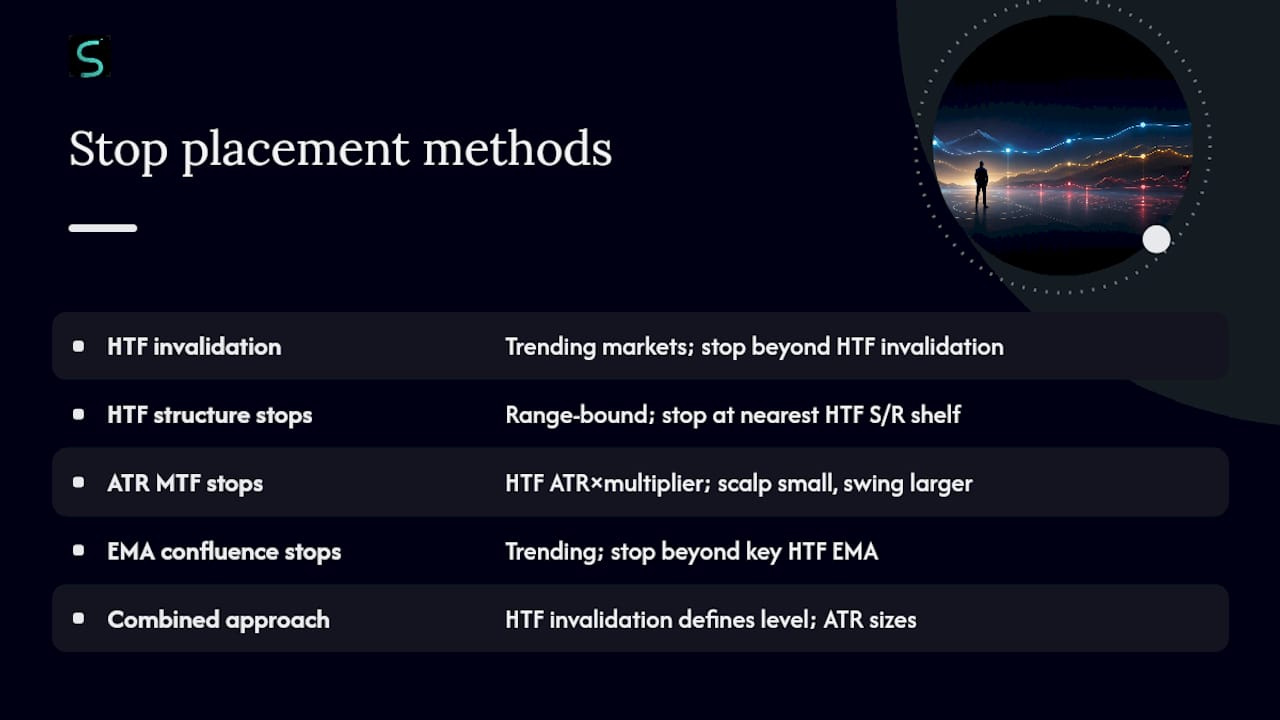
HTF invalidation places your stop beyond the level that would prove the higher-timeframe thesis wrong, a prior swing low on the 1H chart for a daily uptrend, for example. Use this in trending markets where you want the widest reasonable stop that still respects structure.
HTF structure stops are tighter cousins: instead of the full invalidation zone, you use the nearest meaningful support/resistance shelf on the HTF. Better for range-bound conditions where invalidation zones are too far away to be practical.
ATR/volatility-based MTF stops calculate average true range on the higher timeframe and project that distance onto your entry chart. A multi-timeframe ATR trailing stop commonly uses ATR multipliers typically recommended are smaller for scalping with a short 15-minute HTF, moderate for intraday setups, and larger for swing trades. These stops don't repaint once the HTF bar closes, which matters if you're automating alerts.
Moving-average/EMA confluence stops place the stop just beyond a key HTF EMA (the 50 or 200 on the 4H, say) when price is trending cleanly along that average. This works best when the EMA has already acted as support or resistance more than once.
Two quick examples:
Intraday long: Entry on a 15-minute breakout above a consolidation range, HTF is 1-hour. Stop goes below the 1-hour swing low, sized at roughly 2.0× the 1-hour ATR. Risk is 1R; target is 2R at the next 1-hour resistance.

Swing long: Entry on a 4-hour pullback into a rising trendline, HTF is daily. Stop sits below the most recent daily higher low, confirmed with a 3.0× daily ATR buffer. You accept a wider dollar risk in exchange for a trade thesis that can run for days.

Pro Tip: Combine HTF invalidation with LTF ATR sizing rather than picking one. Let the HTF level tell you where the trade is wrong, then let ATR tell you how far that level actually sits in price terms so your position size matches the real risk.
Trailing Stops Across Timeframes Without Getting Whipsawed
Use HTF flips or a fresh HTF invalidation level as your trigger to tighten, and lean on LTF ATR to manage the noise in between. Trailing too aggressively on the entry chart alone is the fastest way to get stopped out of a trade that was actually working.
- Start with the initial HTF invalidation stop from your entry setup.
- At +1R, move the stop to breakeven, no exceptions, no "just a bit more room" thinking.
- When the HTF prints a new higher low (or lower high for shorts), trail the stop to that new structure point.
- On an outright HTF trend flip, either exit fully or trail tight enough that a normal pullback takes you out.
- Take partial profits at 2R and let the remainder ride on the HTF trailing rule.
Pro Tip: Wait for the HTF bar to actually close before you tighten. Acting on an unclosed higher-timeframe candle is how traders get shaken out right before the real move, a pattern the Volatility Stop MTF documentation calls a "limbo" state, where price breaches the LTF stop before the HTF actually confirms.
When Timeframes Disagree: Sizing And Skipping Rules
When your HTF and LTF tell different stories, the HTF wins for trend trades. Trading against HTF context on LTF signals alone is speculation dressed up as a setup.
Say you have a $10,000 account and risk 1% per trade, that's $100. Your stop distance works out to 40 ticks on a futures contract worth $2.50 per tick, so 40 ticks × $2.50 = $100 per contract. That caps you at exactly one contract for that setup, full stop.
When timeframes clash, pick one of these instead of forcing the trade:
- Reduce size by half if you still want exposure to a lower-conviction setup.
- Require extra confluence (volume, a second HTF, order flow) before entering at all.
- Widen the stop only if you can still justify the position size at that new distance.
- Skip it. Genuinely, this is the correct answer more often than traders admit.
Backtesting Your Stop Rules Before You Trust Them
Backtest your rule set across multiple historical HTF/LTF pairs first, then forward-test on out-of-sample data before risking real capital. Skipping this step is how traders end up with rules that sounded good but never actually worked.
- Select at least two market regimes (trending and ranging) in your historical data.
- Resample bars so your LTF and HTF match the pairing you actually trade.
- Apply your entry rule, then your chosen stop method, consistently across every trade.
- Factor in realistic slippage and commissions, not zero-friction fills.
- Reserve a final chunk of data you haven't touched for out-of-sample testing.
Track these metrics: net P/L, win rate, average R multiple, max drawdown, and the percentage of trades closed specifically by an HTF flip versus a hard stop.
- Power-law behavior in price data means occasional outsized moves will blow past what a normal-distribution model expects, so don't undersize your buffer just because your backtest looked clean.
Pro Tip: Don't trust anything under 100 trades. Walk-forward testing, reoptimizing on a rolling window rather than the whole history at once, catches rules that only worked because of one lucky stretch.
Your 7-Point Pre-Trade Stop Checklist
Run this before every entry, it takes less than a minute once it's habit:
- HTF alignment confirmed — your entry direction matches the higher-timeframe trend or key level.
- Stop distance measured in ATR or ticks — you know the exact number before entering.
- Position size calculated from stop distance, not guessed.
- Liquidity checked — thin books widen your effective slippage on stop-outs.
- Economic calendar checked — central bank events can blow through normal volatility ranges in minutes.
- Trailing rule defined in advance, not decided emotionally mid-trade.
- Setup matches your backtested rule, not an improvised variation of it.
A Trader's Notes On Making This A Habit
Checking the HTF before I size anything is non-negotiable at this point, it's the first thing I look at, before the entry chart even loads. I favor non-repainting HTF stops for the obvious reason: a stop that shifts after the fact isn't a real stop. Every trade gets logged, win or loss, and I don't scale size until the log backs it up.
Build Your MTF Stop Rules Into A Working System
Manually recalculating HTF ATR levels and structure zones on every chart gets old fast, and it's exactly where discretionary traders start cutting corners under pressure. Scalping-Algo's indicator suite handles the HTF calculation natively: non-repainting HTF-based stops, adjustable ATR multipliers for scalping, intraday, or swing profiles, and webhook alerts that fire the moment your stop condition triggers on Discord.

Before committing real capital, run your stop rules through the Command Center's backtesting dashboard using the exact ATR multipliers and HTF pairings covered above. Pair that with our take profit and stop loss setup guide if you want to map exits alongside stops in the same workflow. Start with a short trial period and validate the numbers before scaling size, then check the full indicator suite to see which package fits your timeframe pairing.
Frequently Asked Questions
What is a multi timeframe stop in trading? It's a stop-loss level set using a higher timeframe than your entry chart, then sized or trailed with lower-timeframe volatility, typically ATR.
What's the best timeframe combination for day trading stops?
Should I widen my stop when timeframes conflict? Only if the wider distance still fits your position-sizing math. Otherwise reduce size, wait for confluence, or skip the trade.
How do I trail a stop across multiple timeframes? Move to breakeven at +1R, then trail to new HTF structure points only after the HTF bar has closed to avoid premature exits.
Do non-repainting HTF stops matter for automated alerts? Yes. A stop that recalculates after the fact will misfire on live alerts, which is why non-repainting HTF calculation matters for anyone running webhook-based execution.
This article is general information, not a substitute for advice from a qualified financial advisor. Consult a qualified financial professional about your own circumstances before acting on anything here.
Sources
- About - MTF (Multi Time Frame) - Simpler Trading