

Lower timeframe trading is defined as executing trades on charts ranging from 1 minute to 15 minutes, where speed and precision determine profitability. The most effective lower timeframe trading tips center on one principle: disciplined multiple timeframe analysis. Multi-timeframe alignment reduces false signals by 30–40%, which means the majority of losing trades on short charts come from ignoring higher timeframe context. Alexander Elder's triple screen method and the 4–6x timeframe spacing rule are two foundational techniques every serious scalper and day trader needs to understand before touching a 1-minute chart.
1. Why multiple timeframe analysis is the core lower timeframe trading tip
Multiple timeframe analysis is the single most important skill for trading lower timeframes successfully. Without it, you are reading noise and calling it a signal. The top-down approach starts with a higher timeframe to establish directional bias, then drops down to a setup timeframe, and finally uses the lowest timeframe for entry precision.
Each timeframe plays a specific role. The highest chart in your stack defines the trend. The middle chart identifies the setup. The lowest chart triggers the entry. Skipping the top layer is the most common mistake retail traders make, and it costs them on every trade.

Starting analysis top-down filters confirmation bias and improves win rates. When you already know the higher timeframe trend before you look at the 1-minute chart, you stop taking trades against the dominant flow.
Pro Tip: Never open a lower timeframe chart first. Always start with the highest timeframe in your stack, establish your bias, and only then drop down to find your entry.
2. How to use the 4–6x spacing rule for your timeframe stack
Maintaining 4–6x spacing between timeframes prevents redundant data and improves decision quality. This is the rule most traders ignore, and it explains why their multi-timeframe setups feel confusing.
When two timeframes are too close together, for example a 3-minute and a 5-minute chart, they show nearly identical price action. You get no new information. When the gap is too wide, you lose the intermediate context that connects the big picture to your entry. The 4–6x multiplier hits the sweet spot.
Practical stacks that follow this rule include:
- Scalping: 15-minute for context, 5-minute for setup, 1-minute for entry
- Momentum day trading: 1-hour for trend, 15-minute for setup, 5-minute for entry
- Swing-to-intraday: 4-hour for trend, 1-hour for setup, 15-minute for entry
Each combination gives you three distinct layers of information without overlap or gaps.
3. How to select the right lower timeframe combination for your strategy
A 3–5x multiplier between direction and entry charts improves scalping consistency. The exact combination you choose depends on your strategy type, your market, and your session timing.
Liquidity and spread widen during off-peak hours. Trading a 1-minute chart during the Asian session in a low-volume forex pair is a different risk profile than trading the same chart during the London open. Session timing affects which timeframe combinations are viable.
Here is a practical comparison of common timeframe stacks:
| Strategy type | Trend timeframe | Setup timeframe | Entry timeframe | Best for |
|---|---|---|---|---|
| Scalping | 15-minute | 5-minute | 1-minute | Forex, crypto |
| Momentum day trading | 1-hour | 15-minute | 5-minute | Indices, futures |
| Mean reversion | 30-minute | 10-minute | 3-minute | Range-bound markets |
| Swing intraday | 4-hour | 1-hour | 15-minute | Forex, commodities |
Too many timeframes cause analysis paralysis. Three charts are the maximum for most traders. Adding a fourth rarely adds value and usually adds confusion.
Pro Tip: Pick one stack and trade it for at least 30 sessions before changing anything. Consistency builds pattern recognition faster than variety.
For a deeper look at chart multiplier selection for scalping, the principles behind these combinations are worth studying in detail.
4. How to time entries precisely on lower timeframes
Entry timing on lower timeframes separates profitable scalpers from breakeven traders. The most reliable entry method combines a higher timeframe pullback with a Fibonacci retracement level on the lower chart. Using the 5-minute chart for direction and the 1-minute chart for entry at a 50% Fibonacci retracement gives you a defined, repeatable trigger.
Pullback entries outperform breakout entries on lower timeframes because they offer better risk-to-reward ratios. Breakouts on 1-minute charts are frequently false moves driven by spread widening or thin order books. Waiting for the pullback to a key level filters most of those traps.
Key execution rules for lower timeframe entries:
- Confirm the higher timeframe trend direction before placing any trade
- Wait for price to pull back to a structure level or Fibonacci zone on the entry chart
- Use the 15-minute trend as your filter to avoid being shaken out by 1-minute noise
- Set your stop loss based on the setup timeframe, not the entry timeframe
- Enter only when all three timeframes align in the same direction
Pro Tip: If you cannot find a clear trend on the 15-minute chart, do not trade the 1-minute chart. No trend means no trade.
5. Why spread costs can destroy your lower timeframe edge
Spread awareness is a non-negotiable part of any short-term trading guide. Abandon trades if the spread exceeds one-third of your target profit to preserve your edge. This rule eliminates a large category of cost-neutral or losing trades before they happen.
On a 1-minute chart, a 10-pip target with a 4-pip spread leaves you with only 6 pips of real profit potential. That is a 40% cost drag before the market moves a single tick in your favor. Scalpers who ignore spread costs consistently underperform even when their directional calls are correct.
Spread costs spike during news events, session transitions, and low-liquidity periods. Check the spread before every entry, not just at the start of your session. The role of volatility in spread behavior during these windows directly affects whether a lower timeframe trade is worth taking.
6. How to manage trades without emotional exits
Avoid monitoring ultra-low timeframes after entry to prevent emotional exits driven by noise. This is one of the most underrated pieces of day trading advice, and most traders do the opposite.
After you place a trade on a 1-minute chart, switching to watch every tick creates a psychological trap. Normal price fluctuation looks like a reversal. You exit early, the trade hits your original target without you, and you repeat the cycle. The fix is simple: manage the trade on your signal timeframe, not your entry timeframe.
Set your stop and target before entry. Move to the setup timeframe to monitor. Only return to the entry chart if price approaches a key decision level. This single habit reduces premature exits and improves average trade quality significantly.
7. What to do when higher and lower timeframe signals conflict
When higher and lower timeframe signals conflict, the higher timeframe always wins. This rule is absolute. A bullish signal on a 1-minute chart against a bearish 15-minute trend is a low-probability trade, regardless of how clean the setup looks.
Lower timeframe moves often represent corrective pullbacks within larger higher timeframe trends. What looks like a breakout on the 1-minute chart is frequently just a retracement on the 15-minute chart. Trading it as a trend continuation is trading against the dominant flow.
The practical rule: if the higher timeframe trend is down, only take short signals on the lower timeframe. Skip all long signals until the higher timeframe structure changes. This filter alone eliminates a large percentage of losing trades for most retail traders.
8. How to build a consistent backtesting workflow before going live
Backtest 30–50 trades using a fixed hierarchy like Daily, 1-hour, and 5-minute before refining your approach. This number is specific for a reason. Fewer than 30 trades gives you a statistically unreliable sample. More than 50 before your first review slows your learning cycle.
A structured pre-trade checklist prevents impulsive entries. Before every trade, confirm:
- Higher timeframe trend direction is clear
- Setup timeframe shows a valid pattern or structure level
- Entry timeframe signal aligns with the setup
- Spread is within acceptable limits for your target
- Session timing supports liquidity for your chosen pair or asset
Stick to one timeframe stack during backtesting. Switching stacks mid-test invalidates your results. The goal is to build intuition for how your specific combination behaves across different market conditions. A proper backtesting process for retail traders covers the mechanics of doing this correctly without expensive software.
Volume and order flow tools add confirmation on the entry timeframe. They are not required, but they reduce false entries during low-conviction setups.
Key Takeaways
Disciplined multiple timeframe analysis with 4–6x spacing, strict spread checks, and signal-timeframe trade management is the foundation of consistent lower timeframe trading.
| Point | Details |
|---|---|
| Multi-timeframe alignment | Aligning all three timeframes reduces false signals by 30–40% and improves entry quality. |
| 4–6x spacing rule | Keep timeframes 4–6x apart to avoid redundant data and analysis paralysis. |
| Spread cost check | Abandon any trade where the spread exceeds one-third of your target profit. |
| Signal timeframe management | Monitor trades on the setup timeframe, not the entry timeframe, to avoid emotional exits. |
| Higher timeframe dominance | When signals conflict across timeframes, always follow the higher timeframe direction. |
What I've learned from trading lower timeframes the hard way
Most traders approach lower timeframe charts backward. They open the 1-minute chart first, find a signal they like, and then look for higher timeframe confirmation to justify it. That is bottom-up analysis, and it is the fastest way to lose money on short charts. The confirmation you find that way is almost always selective. You see what you want to see.
Starting top-down is not just a technique. It is a discipline that forces you to confront the actual market structure before you commit capital. When I began applying the top-down approach consistently, the number of trades I took dropped significantly. That was the point. Fewer trades, better trades.
The spread rule is the one most traders skip because it feels like a minor detail. It is not. On a 1-minute chart with a 10-pip target, a 3-pip spread means you are already down 30% before the trade starts. Do that ten times a day and the math compounds against you fast.
My strongest advice: pick one timeframe stack, study common beginner mistakes that apply to your setup, and trade that stack exclusively for at least two months. You will learn more from deep familiarity with one combination than from constantly switching between five.
— Tran
Scalping-algo's tools for lower timeframe traders
Applying these principles manually across three charts is demanding. Scalping-algo builds TradingView indicators specifically for traders working on 1-minute to 15-minute charts in forex, crypto, indices, and futures.
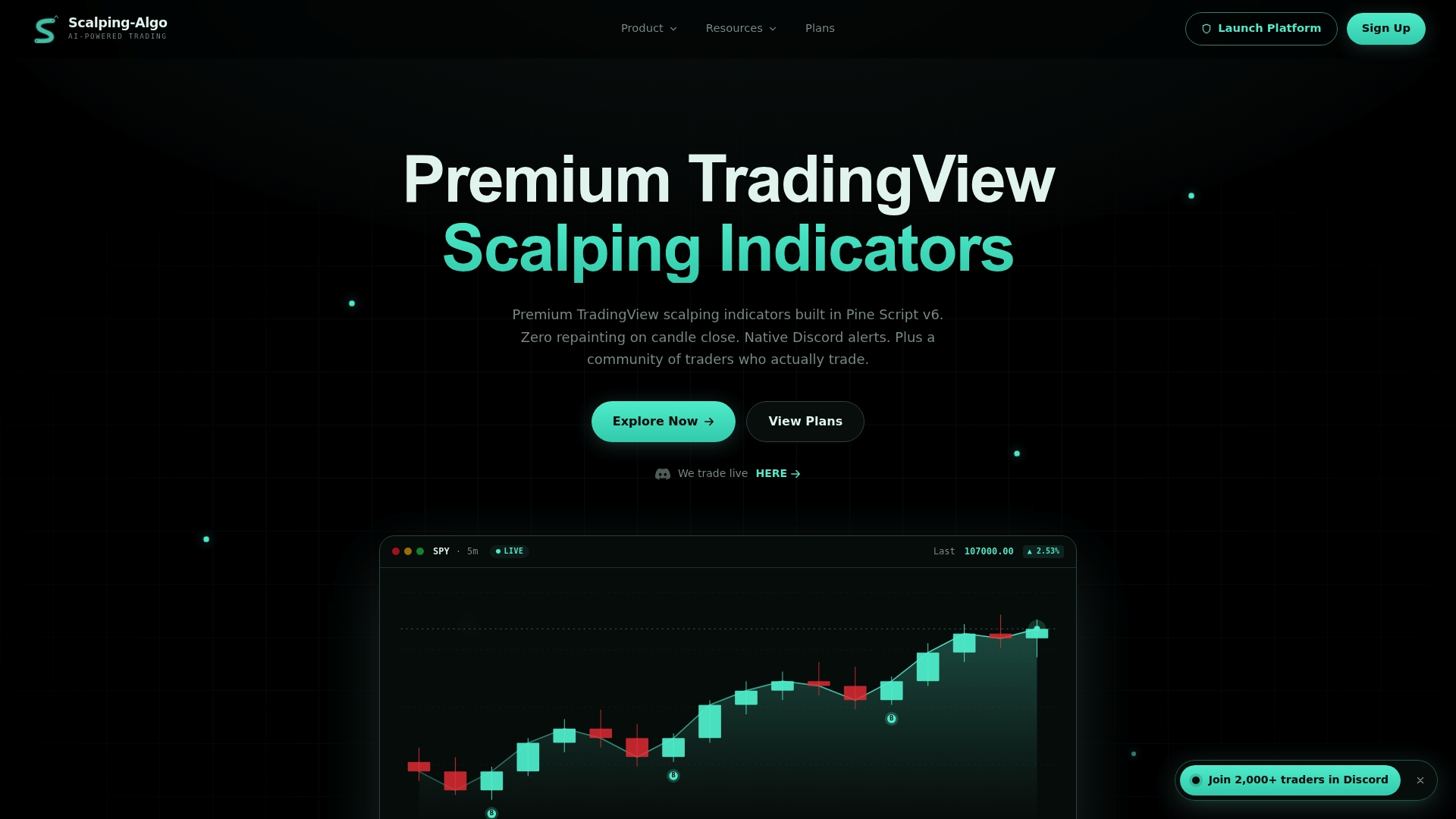
The Algo Master system combines three indicators covering timing, trend, and momentum into a single framework. It generates real-time, non-repainting buy and sell signals aligned with multi-timeframe structure, so you spend less time analyzing and more time executing with confidence. All scripts are open-source and built in Pine Script v6. Explore the full suite of premium scalping indicators and see how they fit your current timeframe stack.
FAQ
What are the best timeframes for scalping forex and crypto?
The most effective scalping stack uses the 15-minute chart for context, the 5-minute chart for setup, and the 1-minute chart for entry. This combination follows the 4–6x spacing rule and gives you three distinct layers of information.
How do I avoid false signals on lower timeframes?
Multi-timeframe alignment reduces false signals by 30–40%. Only take trades where the trend, setup, and entry timeframes all point in the same direction.
What is the 4–6x timeframe spacing rule?
The 4–6x rule means each timeframe in your stack should be four to six times larger than the one below it. This spacing prevents redundant data and keeps each chart providing unique information.
When should I skip a lower timeframe trade?
Skip any trade where the spread exceeds one-third of your target profit, where the higher timeframe trend is unclear, or where the higher and lower timeframe signals conflict. The higher timeframe direction always takes priority.
How many trades should I backtest before trading live?
Backtest 30–50 trades using a fixed timeframe hierarchy before going live. This sample size is large enough to identify patterns and small enough to allow fast iteration on your approach.