

A scale-out indicator is a TradingView tool that signals when to close part of a scalping position so you lock in profit while a portion keeps running. On 1m to 15m charts, this means catching fast moves without surrendering the whole trade to a sudden reversal. Used correctly, it pairs with sound position sizing and clear exit rules rather than replacing them.
TL;DR:
- Scale-out indicators work best when paired with proper position sizing and predefined exit rules, not as standalone tools.
- Using ATR-based targets and confluence signals can improve the reliability of partial exits on fast charts.
- Confirm signals with candle close to avoid repainting issues, especially on 1-minute charts where noise is high.
- Smaller contract sizes, like micro futures, facilitate more precise partial exits than standard contracts.
- Beware of slippage with stop orders during fast, volatile moves; staged limit orders reduce execution risk.
Table of Contents
- Why Scale-Outs Matter for Short-Term Scalping
- How Scale-Out Indicators Decide the Exit Points
- Ready-to-Use Scale-Out Recipes for 1m, 5m, and 15m Charts
- Position Sizing and Contract Choice for Granular Scale-Outs
- Execution Mechanics: Order Types and Slippage on Fast Charts
- Backtesting and Alerts: Validating the Signal Before You Trust It
- Limitations and Test Discipline Before Going Live
- What Experience Trading Fast Charts Teaches About Scaling Out
- How Our Scalping-Algo Suite Fits Into This Approach
- FAQ
- Sources
Why Scale-Outs Matter for Short-Term Scalping
Fast charts punish hesitation. A trade that looks healthy at minute three can reverse by minute five, and on 1m to 15m timeframes that reversal often happens before a trader even registers it. Scaling out addresses this directly: by closing a portion of the position at a defined point, we bank real profit before the market gets a chance to take it back. CME Group's risk management framing treats exits as something planned before entry, not improvised mid-trade.
There's a behavioral piece too. Traders who try to let every trade "run" tend to give back gains out of greed or indecision. A scale-out rule removes that decision from the heat of the moment.
- Partial exits reduce the odds a late reversal wipes out unrealized gains.
- Locking in a chunk of profit short-circuits the urge to hold too long.
- Scale-outs tend to outperform a single fixed take-profit or a naive trailing stop in choppy, fast-reversing conditions.
How Scale-Out Indicators Decide the Exit Points
Not all scale-out logic works the same way, and the method matters as much as the signal itself.
- Fixed-tier targets: a first target (T1) and second target (T2) set at predetermined price distances, simple to backtest and easy to automate.
- ATR-based dynamic targets: exit distances that expand or contract with recent volatility, so a quiet session and a news-driven spike get different treatment.
- Confluence signals: combining trend direction, divergence, order block location, and volume into one higher-confidence exit trigger instead of relying on price alone.
- Volatility gating: suppressing scale-out signals during microspikes or erratic high-frequency noise that would otherwise trigger a premature exit.
Non-repainting design matters more than most traders realize. A signal that only confirms on candle close means the backtest you run today reflects what would have actually printed in real time, not a lagging indicator that rewrote history after the fact.
Pro Tip: Test any scale-out indicator on replay mode first. If the signal changes after the candle closes, it's repainting and the backtest numbers are not trustworthy.
Ready-to-Use Scale-Out Recipes for 1m, 5m, and 15m Charts
Different timeframes call for different target spacing and split ratios. These are starting points to adjust after you've run your own backtests.
- 1-minute recipe: ATR multiplier of 1.0 to 1.2, require two confirmation bars after signal, first target spaced at roughly 1x ATR, close 50% of the position there.
- 5-minute recipe: ATR multiplier of 1.5 to 2.0, two scale-out stages (T1 at 1x ATR, T2 at 2x ATR), gate signals off during volatility spikes above your typical ATR range.
- 15-minute recipe: ATR multiplier of 2.5 to 3.0, wider target spacing to match the slower candle pace, conservative first scale of 30% to let more of the position benefit from the bigger move.
- On 1m charts, confirm the signal candle has fully closed before acting since noise is highest here.
- On 5m charts, a volatility gate helps avoid scaling out into a brief spike that reverses within the same candle.
- On 15m charts, a smaller first-scale fraction keeps more size working toward the larger expected move.
These splits are not fixed law. They're a sensible default for testing, and your own win rate and average runner size should steer any adjustment — see our partner guide on building a risk management workflow for traders for complementary insights. For deeper detail on timeframe-specific mechanics, our 1-minute scalping playbook walks through the fastest end of this range.
Position Sizing and Contract Choice for Granular Scale-Outs
Scale-outs only work cleanly when your position is large enough to split. CME Group's 2% Rule structures this: decide your maximum risk per trade as a percentage of account equity, then size the position so your stop loss equals that risk. Smaller contract sizes, including micro and E-nano futures, let you divide that position into real scale-out steps instead of facing an all-or-nothing exit, a distinction CME Group highlights directly.
Here's a worked example using illustrative numbers only:
With 10 micro contracts instead of one standard-size contract, scaling out at T1 is a clean, partial action rather than a binary close-it-all decision.

Execution Mechanics: Order Types and Slippage on Fast Charts
The order type you choose for a scale-out matters as much as the signal that triggers it. Investor that a stop order is a trigger, not a guarantee: once hit, it becomes a market order, and the fill price can land well away from the stop price during fast moves. A stop-limit order caps the downside of a bad fill but risks not filling at all in a sharp move.
A stop price is a trigger, never a promised execution price, which matters most exactly when scalpers need reliability most: fast, volatile 1m to 15m conditions.
- Prefer staged limit orders or webhook-triggered limit submits for partial exits rather than relying purely on market orders.
- Size each scale-out piece to the liquidity actually visible on the order book, not to the size you wish were there.
- Avoid crossing wide spreads on illiquid instruments where the quoted price and the fillable price diverge.
Our slippage-reduction guide covers four practical levers for tightening execution further.
Backtesting and Alerts: Validating the Signal Before You Trust It
A scale-out indicator is only as good as its backtest, and the backtest is only meaningful if it reflects real trading conditions.
- Track expectancy (average profit per trade after costs), not just win rate.
- Measure runner capture rate: how much of the move your remaining position actually captures after the first scale-out.
- Check max drawdown across the test period, not just the best run.
- Stress-test with commission and slippage assumptions added, since a strategy that only works at zero cost won't survive live trading.
TradingView's Pine Script strategy functions let you simulate multiple partial exits directly in a backtest, and webhook alerts extend that signal into real-time execution. Our Command Center dashboard ties alerts, backtesting, and Discord webhook delivery together so a confirmed signal reaches your execution layer with minimal lag. Our guide on algorithmic trading benefits covers why that latency gap matters for scalpers specifically.
Limitations and Test Discipline Before Going Live
No scale-out indicator removes execution risk. Stop orders are triggers, not guaranteed fills, so plan for slippage rather than assuming a clean exit every time. Overfitting is the other common trap: a split that looks perfect on one symbol over one month often falls apart on a different instrument or session, so simpler fixed splits tend to hold up better than heavily tuned ones.
- Paper trade any new scale-out setup for a fixed number of trades before risking real capital.
- Validate the same parameters across multiple symbols and sessions, not just the one that produced the best backtest.
- Keep a trade log that records entry, scale-out points, and actual fill price versus signal price.
Pro Tip: Log the gap between your signal price and your actual fill for the first 20 live trades. That gap tells you more about real-world slippage than any backtest.
What Experience Trading Fast Charts Teaches About Scaling Out
We've found non-repainting signals and webhook alerts matter more than any single parameter tweak, because a scale-out plan is worthless if the signal rewrites itself after the fact or arrives too late to act on. The traders who do this well aren't chasing a perfect indicator. They're logging trades, comparing fills to signals, and adjusting splits based on what their own data shows. Test small, write it down, and let a community of other traders doing the same sharpen your edge faster than solo guessing ever will.
— Tran
How Our Scalping-Algo Suite Fits Into This Approach
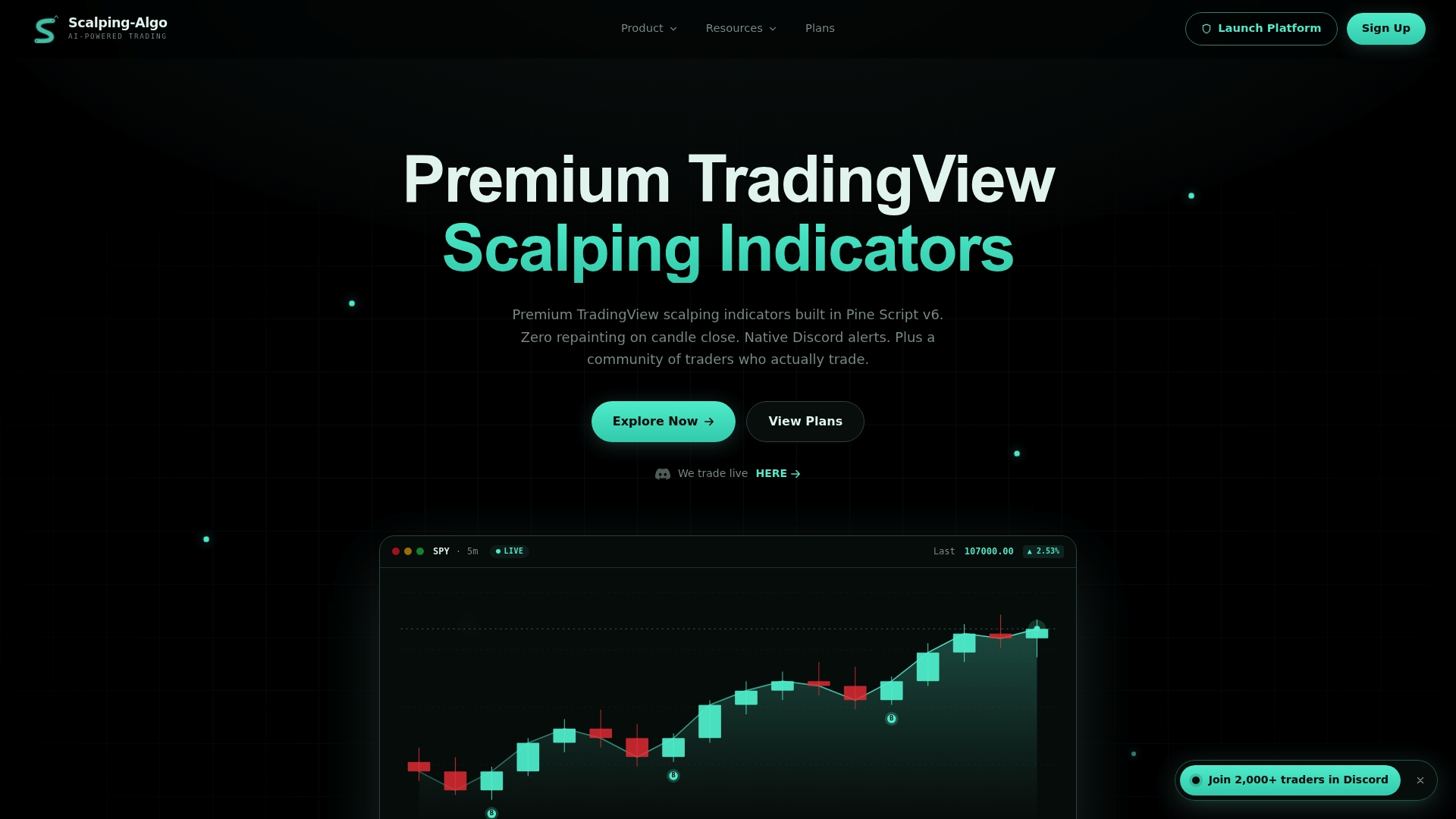
Everything in this guide maps directly to what we built. Our Pine Script v6 indicators generate non-repainting signals confirmed on candle close, with predefined parameter recipes for 1m to 15m charts so you're not starting from a blank script. Native webhook alerts push confirmed signals straight to Discord or your own execution layer, and our backtesting dashboard inside the Command Center lets you validate a scale-out plan before risking live capital.
- Explore Smart Scalping Signals for real-time buy and sell signals built for scale-out timing.
- Check Edge Finder for confluence and volatility gating inputs.
- Review Momentum Oscillator to confirm runner strength after a first scale-out.
All our scripts are open-source, so inspect the logic before subscribing. Plans start at monthly, yearly, or one-time lifetime purchase options; current prices are on the pricing page at Scalping-algo.
FAQ
What does a scale-out indicator actually signal?
It signals a specific price point or condition, such as an ATR-based target or a confluence trigger, at which you'd close part of your position rather than all of it. The goal is to lock partial profit while leaving a portion open to capture further movement.
How much of a position should you scale out at the first target?
Adjust based on your own backtest results and runner capture rate.
Can a stop order guarantee my scale-out fill price?
No. Investor.gov explains that a stop order becomes a market order once triggered, and the execution price can differ from the stop price, especially during fast or volatile moves. Staged limit orders or webhook-triggered limit submits typically reduce that risk.
Do I need large contracts to scale out effectively?
Not necessarily. Smaller contract sizes, including micro and E-nano futures, let traders split a position into multiple real scale-out steps, where a single large contract often forces an all-or-nothing exit, according to CME Group.
Does Scalping-Algo include scale-out signals in its indicators?
Yes, our Smart Scalping Signals and related tools include non-repainting entry and exit signals with webhook alerts designed to support staged partial exits. All scripts are open-source, so you can review the exact logic before relying on it in live trading.