

Transparent trading software is defined as any platform that shows traders the full reasoning behind every trade decision, not just the signal itself. This includes plain-English rationales, real-time audit trails, risk scores, and custody safeguards that protect your funds. The industry term for the most advanced version of this is "explainable trading software," and understanding the difference between that and a black-box system is the single most important skill you can develop as a trader in 2026. Scalping-algo is built on these exact principles, with open-source Pine Script v6 indicators that let you see exactly how every signal is generated.
What does transparent trading software explained actually mean?
Transparent trading software in 2026 is defined by three pillars: explainability, audit-ready data, and accountable decision-making. Explainability means the platform tells you why a trade was triggered, not just that it was triggered. Audit-ready data means every order state, entry price, stop level, and P&L figure is logged with a timestamp you can review later. Accountable decision-making means the system cannot hide errors or rewrite history after the fact.
The contrast with black-box systems is stark. A black-box system gives you a buy or sell signal with no context. You cannot verify the logic, reproduce the result, or learn from the trade. Transparent platforms flip this entirely. They expose the signal generation process, the confidence score behind it, and the risk parameters that shaped the decision.

This shift matters most for scalpers and day traders. You execute dozens of trades per session. Without visibility into each decision, you cannot identify which setups are working and which are draining your account. Transparency turns every trade into a data point you can actually use.
What features make trading software truly transparent?
The features that separate genuinely transparent platforms from marketing claims fall into four clear categories.
- Plain-English trade rationales. Agentic trading platforms use AI agents that narrate trade logic, conviction scores, and risk levels in language you can read and verify. This is fundamentally different from a fixed rule bot that fires when two moving averages cross.
- Real-time audit trails. Audit trails log every order state transition with timestamps and actor IDs. Without this, you cannot scientifically analyze your strategy or prove what happened during a disputed trade.
- Non-custodial or smart-custody architecture. Non-custodial API integrations keep your funds in your own brokerage account. OAuth or API key access lets you revoke platform permissions at any time without transferring asset ownership. This eliminates counterparty risk entirely.
- Risk gating and dynamic model retraining. A professional-grade system follows a strict architecture: connectivity, feed handling, book building, signal generation, risk gating, and order management, in that exact order. Skipping or misordering these steps causes failures in volatile markets.
Pro Tip: Before committing to any platform, ask one question: can you export a full trade log with timestamps for every order state? If the answer is no or unclear, the platform is not truly transparent.
Scalping-algo's indicators are built in Pine Script v6 and published as open-source scripts. Every calculation is visible. Every signal condition can be read, tested, and verified by any trader with a TradingView account.
How does transparent trading software benefit traders?
The practical advantages of transparent platforms show up directly in your trading results, not just in theory.
- Reduced information asymmetry. Market transparency reduces information asymmetry by giving retail traders real-time access to order book depth and trade volume. This levels the playing field between institutional desks and individual traders.
- Lower price slippage. Real-time order book data lets you see where liquidity actually sits before you enter. Scalpers and day traders who rely on high-frequency movements benefit the most from this, because even a few basis points of slippage compounds across dozens of trades per day.
- Better strategy learning. When a platform explains its decisions, you learn the market conditions that produce winning setups. Over time, this builds genuine trading skill rather than blind dependence on a signal.
- Improved price discovery. Markets with high transparency incorporate new information into asset prices faster. This reduces mispricing risk and builds trust across all participants, from retail scalpers to institutional funds.
Transparency in trading is not just a feature. It is a market mechanism that makes prices fairer and execution more reliable for every trader in the system.
The confidence benefit is underrated. When you understand why a signal fired, you execute with conviction. When you are guessing, you hesitate, size down, or exit early. Those behavioral errors cost more than most traders realize.
How to choose transparent trading software for your strategy
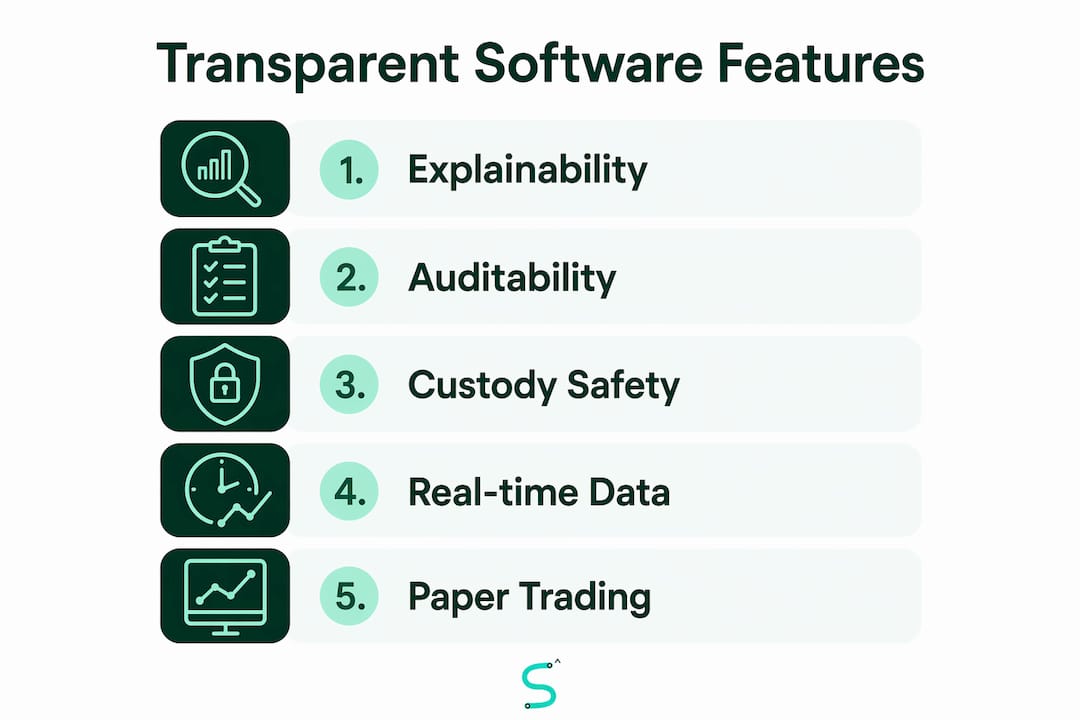
Evaluating a platform for genuine transparency requires a structured checklist. Use these criteria before you commit real capital.
The transparency checklist
Explainability. Does the platform provide a written or logged rationale for each trade? Generic platforms show signals. Transparent platforms show the logic behind them.
Auditability. Can you access immutable, timestamped logs of every order state change, including rejections and modifications? This is the technical standard for true transparency.
Custody safeguards. Does the platform use non-custodial API access? You should be able to revoke permissions without contacting support. Any platform that holds your funds directly introduces counterparty risk that transparency cannot fix.
Real-time data quality. Does the platform feed live order book depth and volume, or delayed data? For scalpers operating on 1-minute to 15-minute timeframes, delayed data is not a minor inconvenience. It is a structural disadvantage.
Simulation before live trading. Paper trading with live market feeds is a mandatory validation step before deploying real capital. Platforms that skip this feature are asking you to test your strategy with real money. That is a red flag.
Pro Tip: Run any new strategy in paper trading mode for at least two weeks across different market conditions. Check execution latency, signal accuracy, and drawdown behavior before going live.
When comparing platform categories, entry-level signal apps typically offer signals with no rationale and no audit trail. Mid-tier algorithmic platforms add backtesting but often lack real-time audit logs. Enterprise-grade transparent platforms provide all five criteria above. Scalping-algo sits in the latter category, with real-time scalping signals and open-source code that satisfies the auditability standard by design.
Common misconceptions about transparent trading software
Several persistent myths cause traders to accept less transparency than they deserve.
- "Visible signals equal transparency." Seeing a buy or sell arrow on a chart is not transparency. True transparency includes the audit trail, the rationale, and the custody model. A platform can show signals while hiding everything else.
- "All algorithmic bots are the same." Agentic AI trading agents reason over live market data and explain their decisions in plain English. Rule-based bots execute fixed conditions with no reasoning layer. The difference in explainability is significant.
- "Transparency eliminates trading risk." Transparency reduces risk by improving your understanding of each trade. It does not remove market risk, volatility, or the possibility of loss. Any platform claiming otherwise is misleading you.
- "Open-source means unverified." Open-source code is the highest standard of transparency in software. Every calculation is public and peer-reviewable. Closed-source platforms ask you to trust a black box.
"The most effective transparent platforms base their trustworthiness on atomic, auditable state changes for each trade, rather than just exposing signals." — Quant trading platform analysis
Understanding these distinctions protects you from platforms that use "transparency" as a marketing term without delivering the technical substance behind it. When you evaluate a platform, ask for the audit log format, the custody model documentation, and the signal rationale structure. If a vendor cannot answer those three questions clearly, move on.
Key takeaways
Transparent trading software works because it combines explainability, audit-ready data, and non-custodial custody into a single accountable system that traders can verify, learn from, and trust.
| Point | Details |
|---|---|
| Explainability is the core standard | Platforms must provide plain-English rationales for every trade, not just signals. |
| Audit trails are non-negotiable | Timestamped logs of every order state change are required for true transparency. |
| Non-custodial access protects your funds | API-based integrations let you revoke permissions anytime without transferring asset ownership. |
| Paper trading validates before live deployment | Simulation with live market feeds is a mandatory step to check latency and strategy logic. |
| Transparency improves trader skill over time | Understanding why signals fire builds genuine market knowledge, not just signal dependence. |
Why I think most traders underestimate what transparency actually costs them
Most traders focus on win rate and ignore the cost of opacity. I have watched traders run black-box systems for months, hit a drawdown, and have no idea whether the strategy broke or the market changed. That is not a risk management problem. It is a transparency problem.
The traders who improve fastest are the ones who can review every trade with full context. They know the entry condition, the confidence score, the market structure at the time, and the exit logic. That feedback loop is what separates traders who grow from traders who spin in place.
The shift toward explainable AI trading agents is the most important structural change in retail trading right now. These systems do not just execute. They teach. Every trade becomes a lesson because the reasoning is visible. That is the future of retail investing, and it is already here for traders who know where to look.
My honest view: if you cannot read the code or access the audit log, you do not own your strategy. You are renting someone else's black box. Scalping-algo's open-source approach exists precisely because we believe traders deserve to own their edge, not just subscribe to it.
— Tran
Scalping-algo's approach to transparent trading tools
Scalping-algo builds every indicator with transparency as a technical requirement, not a feature checkbox. All scripts are open-source in Pine Script v6, so you can read every signal condition, test every parameter, and verify every result independently.
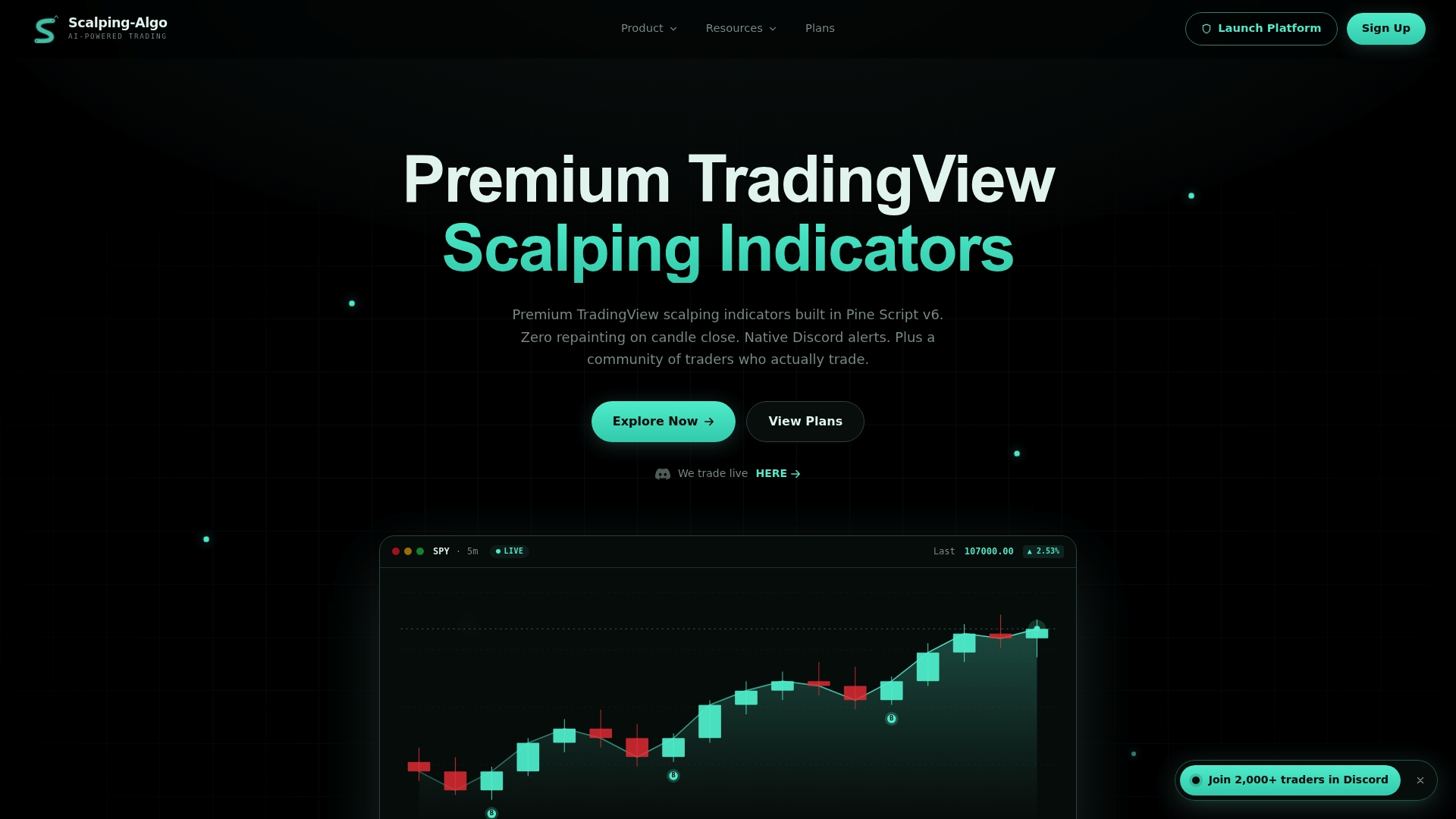
The premium scalping indicators on TradingView generate real-time, non-repainting buy and sell signals across crypto, forex, indices, and futures. The Command Center dashboard integrates alerts, backtesting, and audit-ready signal logs in one place. For traders who want a structured system, the Algo Master 3-indicator suite provides a complete transparent trading framework with clear entry, stop, and target levels on every signal. You can also review investment platform standards to benchmark what genuine transparency looks like before you choose any platform.
FAQ
What is transparent trading software?
Transparent trading software is a platform that provides plain-English rationales, timestamped audit trails, and non-custodial fund access for every trade. It differs from black-box systems by making signal logic, risk scores, and execution records fully visible to the trader.
How does transparency reduce price slippage?
Real-time order book depth and volume data let traders see where liquidity sits before entering a position. This reduces slippage by allowing more precise entry timing, which is critical for scalpers and day traders executing high-frequency strategies.
What is the difference between an AI trading agent and a rule-based bot?
An AI trading agent reasons over live market data and explains its decisions in plain English, including conviction scores and risk levels. A rule-based bot executes fixed conditions with no reasoning layer and provides no rationale for its actions.
Why is paper trading required before going live?
Paper trading with live market feeds validates strategy logic, execution latency, and risk management before real capital is at risk. Skipping this step is the leading cause of retail strategy failures during live market transitions.
Does transparency eliminate trading risk?
Transparency reduces risk by improving your understanding of each trade decision and market condition. It does not remove market risk, volatility, or the possibility of loss. No software can eliminate those factors.