

Demo trading is a simulated trading method that uses virtual funds to replicate real market conditions without risking actual capital. Think of it as a practice account where every trade, chart, and order type mirrors what you'd encounter in a live market. Brokers and platforms like MetaTrader 4 (MT4), MetaTrader 5 (MT5), and cTrader offer demo accounts that are free to open and require no financial commitment. For anyone asking what is demo trading, the short answer is this: it's the safest way to learn how markets work before putting real money on the line.
How does demo trading work in practice?
A demo account is a paper trading environment funded with virtual money, typically between $5,000 and $100,000 depending on the broker. That range gives you enough buying power to simulate realistic position sizing across forex, crypto, indices, and futures.
Getting started is fast. Registration takes minutes, often requiring only an email address and password. No identity verification, no deposit. You get instant access to a full trading terminal.
Once inside, demo platforms mirror the live environment closely. Here's what you typically get:
- Real-time market data across multiple asset classes
- Full order types: market orders, limit orders, stop-loss, and take-profit
- Leverage settings that match the broker's live account conditions
- Charting tools with technical indicators and drawing tools
- Simulated trade history and performance reports
Platforms like MT4 and MT5 are the most widely used. cTrader is popular among forex and CFD traders for its clean interface and depth-of-market display. All three support demo accounts that run on the same infrastructure as their live counterparts.
The one caveat: demo accounts have a shelf life. Most brokers reset or expire them after 30–90 days of inactivity. Plan your practice window intentionally.
What are the benefits of demo trading?
Demo trading is an essential learning tool for mastering platform mechanics and avoiding costly mistakes before risking real capital. That applies to beginners and experienced traders alike.
Here are the core benefits:
- Zero financial risk: You test ideas, make mistakes, and learn without losing money.
- Platform familiarity: You learn where every button, order type, and chart setting lives before it costs you.
- Strategy testing: You run a trading plan through real market conditions to see if it holds up.
- Broker evaluation: You assess execution speed, spreads, and platform stability before committing funds.
- Algorithm testing: Professional traders use demo accounts to test new algorithmic code and platform updates, not just beginners.
The last point surprises most new traders. Demo accounts are not just for learning the basics. Quant traders and system developers use them every time they push a code update or backtest a new signal set.
Building confidence is another underrated benefit. Entering your first live trade with 50 or 100 demo trades behind you is a completely different experience than going in blind.
Pro Tip: Treat every demo trade as if real money is on the line. Set stop-losses, size positions correctly, and log every trade. The discipline you build now carries directly into live trading.
How does demo trading differ from live trading?
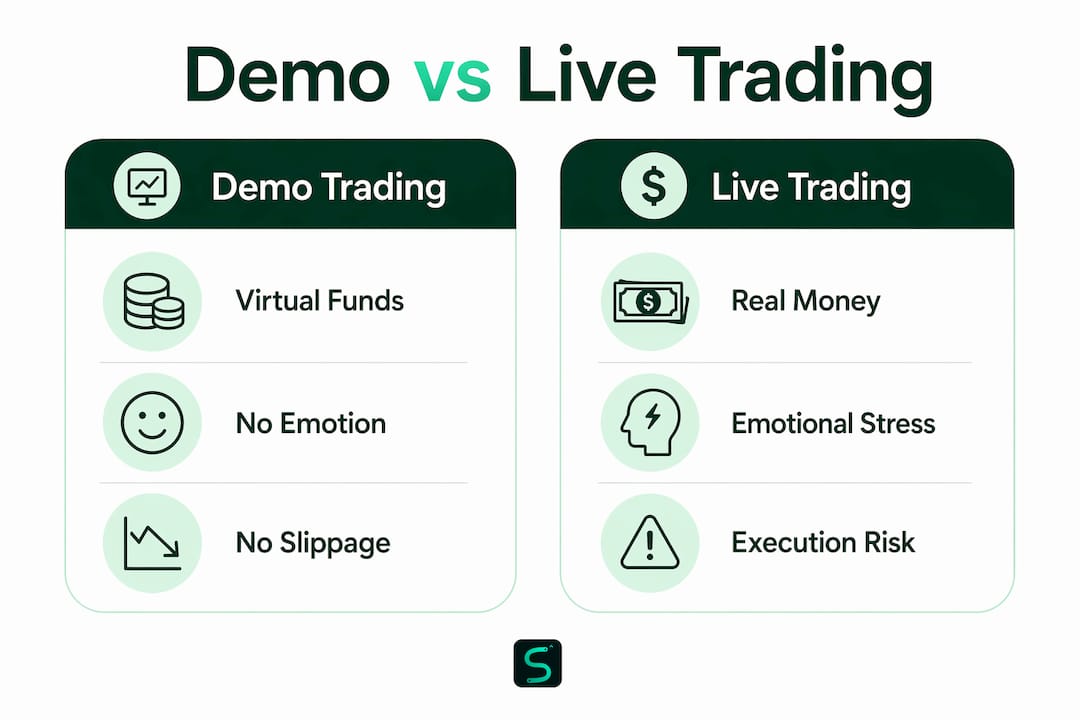
Demo and live trading use the same charts and data, but the experience is fundamentally different. The biggest gap is psychological. Without real loss risk, traders don't feel the fear or greed that drives most live trading mistakes. That emotional absence creates a false sense of competence.
Execution is another area where demo falls short. Slippage and margin calls are not accurately replicated in demo environments. In live trading, a fast-moving market can fill your order at a worse price than expected. Demo accounts typically fill at the exact price you see, which overstates your real-world performance.
Here's a direct comparison:
| Factor | Demo Trading | Live Trading |
|---|---|---|
| Capital at risk | Virtual funds only | Real money |
| Emotional pressure | Minimal | High (fear, greed, FOMO) |
| Order execution | Ideal fills, no slippage | Slippage, partial fills possible |
| Margin calls | Rarely triggered accurately | Real consequences |
| Psychological growth | Limited | Significant |
| Strategy validation | Good for mechanics | True performance test |
Demo success does not guarantee live success. A trader who profits consistently on demo can still blow a live account in the first week. The mechanics transfer. The emotional management does not.
Pro Tip: Before going live, review your demo trade journal and ask: "Would I have held this trade if $500 of my own money was at stake?" If the answer is no, you're not ready yet. Work on your trading psychology before making the switch.
How to use demo trading effectively
Getting the most from a demo account requires structure. Random clicking through charts teaches you very little. Here's a proven approach:
- Set a defined testing period. Forward test for at least 1 month for intraday strategies and 3 months for daily timeframe strategies. Shorter periods don't capture enough market conditions.
- Trade with realistic position sizes. If your live account will start with $1,000, don't trade a $50,000 demo balance like it's unlimited. Set your virtual balance to match your planned live capital.
- Keep a trading journal. Log every trade: entry price, exit price, reason for entry, and outcome. Patterns in your losses are more valuable than your wins.
- Apply strict risk management. Use a fixed risk per trade, such as 1–2% of your virtual balance. This builds the habit before real money is involved.
- Build a tested trading strategy before going live. Don't transition until you have a documented plan with defined entry rules, exit rules, and risk parameters.
- Transition gradually. Consistent demo profitability over 2–3 months signals readiness. Start live trading with the smallest position sizes your broker allows.
The goal is to use demo as a temporary training ground, not a permanent home. Staying in demo indefinitely is its own trap.
Pro Tip: Use stock trading discipline practices to structure your demo sessions. Consistent routines, pre-trade checklists, and post-trade reviews separate traders who improve from those who just practice.

Common misconceptions about demo trading
Several beliefs about demo accounts lead traders astray. Knowing them upfront saves you time and money.
- "Demo profits mean I'm ready to go live." Demo profit is a necessary condition, not a sufficient one. The psychological gap between virtual and real money is real and significant.
- "I'll use demo until I'm consistently profitable." Extended demo use is discouraged. At some point, only live trading teaches what live trading demands. A finite 1–3 month window is the standard recommendation.
- "Execution on demo is the same as live." It is not. Demo environments don't replicate slippage or margin dynamics accurately. Your live fills will often be worse.
- "Risk management doesn't matter on demo." Treating virtual money carelessly is the most common demo mistake. It builds bad habits that carry directly into live trading.
- "Over-leveraging on demo is fine for learning." Using 50:1 leverage on a demo account when you plan to trade 5:1 live creates a completely false picture of risk and reward.
The traders who get the most from demo accounts are the ones who treat them like live accounts from day one.
Key takeaways
Demo trading builds the mechanical skills and strategic foundation every trader needs, but emotional readiness for live trading can only come from trading with real money.
| Point | Details |
|---|---|
| Demo trading defined | A simulated account using virtual funds to practice trading without financial risk. |
| Recommended testing period | Use demo for 1 month (intraday) or 3 months (daily strategies) before going live. |
| Biggest demo limitation | Emotional pressure from real loss risk is absent, creating a false confidence gap. |
| Execution differences | Slippage and margin calls are not accurately replicated in demo environments. |
| Transition strategy | Start live trading with small position sizes after consistent demo profitability over 2–3 months. |
Demo trading is a starting line, not a finish line
I've watched a lot of traders spend six months or more in demo accounts, convinced they're not ready yet. The irony is that the longer you stay in demo, the more you delay the one thing that actually makes you a better trader: experiencing real loss.
Demo accounts are genuinely useful. They teach you platform mechanics, help you build a live trading foundation, and let you test ideas without financial damage. I'd never skip that phase. But I've also seen traders who were profitable on demo for months fall apart the moment real money was involved. The mechanics were there. The emotional wiring wasn't.
The best use of a demo account is deliberate and time-boxed. Pick a strategy, test it for 60–90 days with realistic position sizes, journal every trade, and then make the move. Don't wait for perfection. Perfection in demo is a trap. What you need is enough data to know your edge is real and enough self-awareness to know your risk tolerance.
The traders who transition well are the ones who treated demo seriously from the start. They didn't overtrade, didn't ignore stop-losses, and didn't celebrate virtual wins like they were real. They used demo as a behavioral rehearsal, not a video game.
Go in with a plan. Get out on schedule. Then trade small and learn fast.
— Tran
Take your demo practice further with Scalping-algo
Once you've built your foundation in demo, the right tools make the transition to live trading significantly cleaner. Scalping-Algo's premium TradingView indicators are built specifically for short-term traders across crypto, forex, indices, and futures. Every signal is real-time and non-repainting, so what you test in demo is exactly what you get live.
The Algo Master 3-indicator system is a strong starting point for demo users ready to add structure to their strategy. It combines entry signals, confluence confirmation, and volatility filters into one clean system. Test it in demo first, then carry it into live trading with confidence. Scalping-Algo also includes a full Command Center with backtesting, alerts, and a Discord community for live mentorship sessions.
FAQ
What is a demo account in trading?
A demo account is a simulated trading account funded with virtual money that replicates live market conditions. It lets traders practice order execution, test strategies, and learn platform tools without risking real capital.
How long should i use a demo account before going live?
The recommended period is 1 month for intraday strategies and 3 months for daily trading strategies. Consistent profitability over that window signals you're ready to transition with small live positions.
Is demo trading worth it for beginners?
Yes. Demo trading is the most direct way to learn platform mechanics, practice risk management, and test a strategy before committing real funds. The key is treating it with the same discipline you'd apply to a live account.
Why do traders fail after succeeding on demo?
The primary reason is the psychology gap. Demo trading removes the emotional stress of real loss, which means traders haven't developed the fear management and discipline that live trading demands.
Can experienced traders benefit from demo accounts?
Absolutely. Professional traders and algorithmic developers use demo accounts to test new code, validate strategy updates, and evaluate broker execution before deploying changes to live systems.