

An ATR filter gates trades by volatility, letting entries fire only when the market has room to move. That single gate cuts choppy false entries, standardizes stop distance, and normalizes position size across symbols. Below is the full rules card, tuning guidance, and backtest checklist to make it testable today.
TL;DR:
- ATR filters perform best when tailored to specific timeframes and markets, with a default 14-period ATR often providing a balanced response.
- Using ATR% thresholds around 1-2% is suitable for swing traders, while lower or higher values are better tuned to day trading or longer-term setups.
- Combining ATR with a trend filter, such as a moving average, helps improve trade quality and reduces false signals.
- Over-filtering by stacking multiple ATR conditions can eliminate the strategy's edge, so stick to two or three primitives for robustness.
- Backtest results are most reliable when including at least 100 trades, with stress-testing on parameters to prevent overfitting.
Table of Contents
- How ATR Is Calculated (and Why ATR% Matters More Than Raw ATR)
- Common ATR Filter Types and How to Build Each One
- Your Copy-Paste ATR Filter Rules Card
- Tuning ATR Length and Thresholds Without Overfitting
- ATR-Based Stops, Trailing Exits, and Position Sizing
- Backtesting Your ATR Filter and the Pitfalls That Break It
- How Scalping-Algo Supports ATR Filter Workflows
- When ATR Is the Right Volatility Filter, and When It Isn't
- Get Your ATR Filter Rules Running Without Building From Scratch
- Sources
- FAQ
How ATR Is Calculated (and Why ATR% Matters More Than Raw ATR)
True Range starts simple: it's the largest of three values, the current high minus the low, the high minus yesterday's close, or the low minus yesterday's close. Wilder's Average True Range smooths that True Range over a lookback period, with 14 bars as the default across almost every platform, TradingView included.
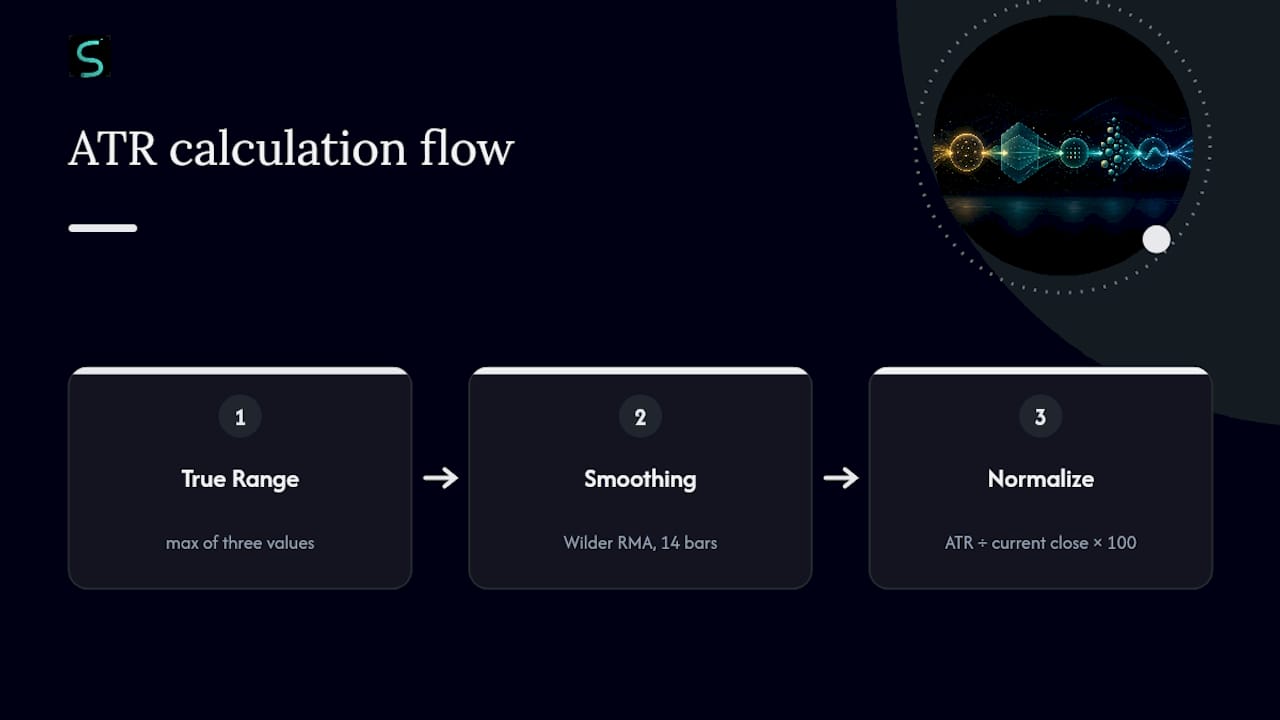
Smoothing method changes the personality of the line. Wilder's original method uses RMA (a rolling moving average), which reacts slower and produces fewer whipsaws than a straight SMA of the same length. Swap in an EMA and the ATR line tightens up, reacting faster to fresh volatility bursts, but it also chases noise more on lower timeframes. Most traders stick with the RMA default unless they have a specific reason to change it.
ATR values are not comparable across symbols. A stock trading at $500 will show a much larger raw ATR than one trading at $20, even if both are equally volatile in percentage terms. That's the entire reason ATR% exists: divide ATR by the current close, multiply by 100, and you get a normalized number you can compare across a crypto pair, an index future, and a forex cross without doing mental gymnastics.
One thing ATR never tells you: direction. A rising ATR means bars are getting bigger, full stop. It says nothing about whether price is trending up, down, or grinding sideways with wide, chaotic swings. Traders who forget this pair ATR with a trend filter, which is exactly what the rules card below does.
Common ATR Filter Types and How to Build Each One
Every ATR filter is a gatekeeper, but the gate's shape depends on what you're trading and how many symbols you're scanning at once.
- Absolute ATR threshold: require ATR(14) to exceed a fixed number of points or pips. Works well on a single symbol you know intimately, where "20 pips of ATR" always means the same thing.
- ATR percent-of-price: require ATR% to clear a cutoff like 1%. This is the right choice for multi-symbol portfolios or cross-asset screening, since it keeps the gate scale-free whether you're scanning Bitcoin or a small-cap stock.
- ATR regime filter: require ATR(14) to sit above its own moving average, commonly SMA(ATR,50). This flags a sustained volatility expansion rather than a single loud candle, which matters if you're building a swing system that needs the regime to hold for several bars.
- Expansion/contraction filters: measure the rate of change in ATR itself. A sharp expansion often precedes breakout continuation, while contraction (ATR compressing toward multi-week lows) tends to precede a squeeze, useful for mean-reversion or pre-breakout setups.
- Percentile filters: rank current ATR against its own trailing history (say, the last 100 bars) and only trade above the 60th or 70th percentile. This adapts automatically as an asset's baseline volatility drifts over months.
- Spike caps: set an upper bound too. A gap-driven ATR spike from an earnings surprise or a flash crash is not tradable volatility, it's noise with teeth, so many rules cards skip entries when ATR% exceeds roughly 3 to 4 times its typical range.
Practitioner writeups converge on these same handful of primitives again and again, which is exactly why a compact rules card built from two or three of them tends to generalize better than a filter stack with ten conditions layered on top of each other.
Your Copy-Paste ATR Filter Rules Card
Here's a starter configuration you can drop into Pine Script, a spreadsheet, or a broker's strategy tester today. It's deliberately boring. Boring survives contact with real markets better than clever.
- Timeframe and market: pick one liquid instrument and one timeframe first (a 5-minute crypto chart or a daily forex pair), never test across a dozen markets simultaneously on day one.
- Trend filter: close above EMA(200) for longs, below for shorts. This handles the direction problem ATR can't solve on its own.
- Setup trigger: a pullback to a short moving average followed by a reversal candle, or whatever entry logic your existing system already uses.
- ATR gate: ATR(14)% > 1.0%, OR ATR(14) > SMA(ATR(14), 50). Pick one, not both, to start.
- Initial stop: entry price minus 2×ATR(14) for longs (entry plus 2×ATR for shorts).
- Target: 3×ATR(14) from entry, giving a 1.5 reward-to-risk ratio before costs.
- Trail: once price moves 1×ATR in your favor, trail the stop at 2×ATR behind the highest close reached.
- Position size: risk a fixed dollar amount per trade divided by the stop distance in dollars, not a fixed share count.
- Max exposure: cap total open risk at a fixed percentage of account equity, and stop trading for the day after two consecutive stop-outs.
- Journal every trade: entry ATR%, stop distance, result, and whether the ATR gate was near its threshold or comfortably clear of it.
Pro Tip: *Log the ATR% reading at the exact moment of entry, not just at signal generation.
Tuning ATR Length and Thresholds Without Overfitting
ATR length changes how fast the filter reacts, and the tradeoff is the same one every smoothing decision runs into. A 7-period ATR reacts quickly, useful on lower timeframes where regimes shift in hours, but it also swings around more and can flip your gate on and off within the same session. The 14-period default balances responsiveness against stability well enough that most traders never need to touch it. A 21-period ATR smooths further still, better suited to daily or weekly swing systems where you want the gate to reflect weeks of behavior, not the last few candles.
Threshold selection should follow your holding period, not a number you saw in a forum post. Swing traders holding for days typically look for 1% to 2% or higher, depending on the asset class. There's no universal number, only a number that matches the noise floor of the instrument you're actually trading.
Before locking in any threshold, run three diagnostics. Count how often your stop gets touched relative to your target across the sample. Measure how much of the day's actual range your entries capture on average. And check trade frequency, because a filter tuned so tight it produces four trades a month isn't a filter, it's an accident.
Then stress it. If a small nudge in the threshold flips the strategy from profitable to broken, the setting was never robust to begin with.
ATR-Based Stops, Trailing Exits, and Position Sizing
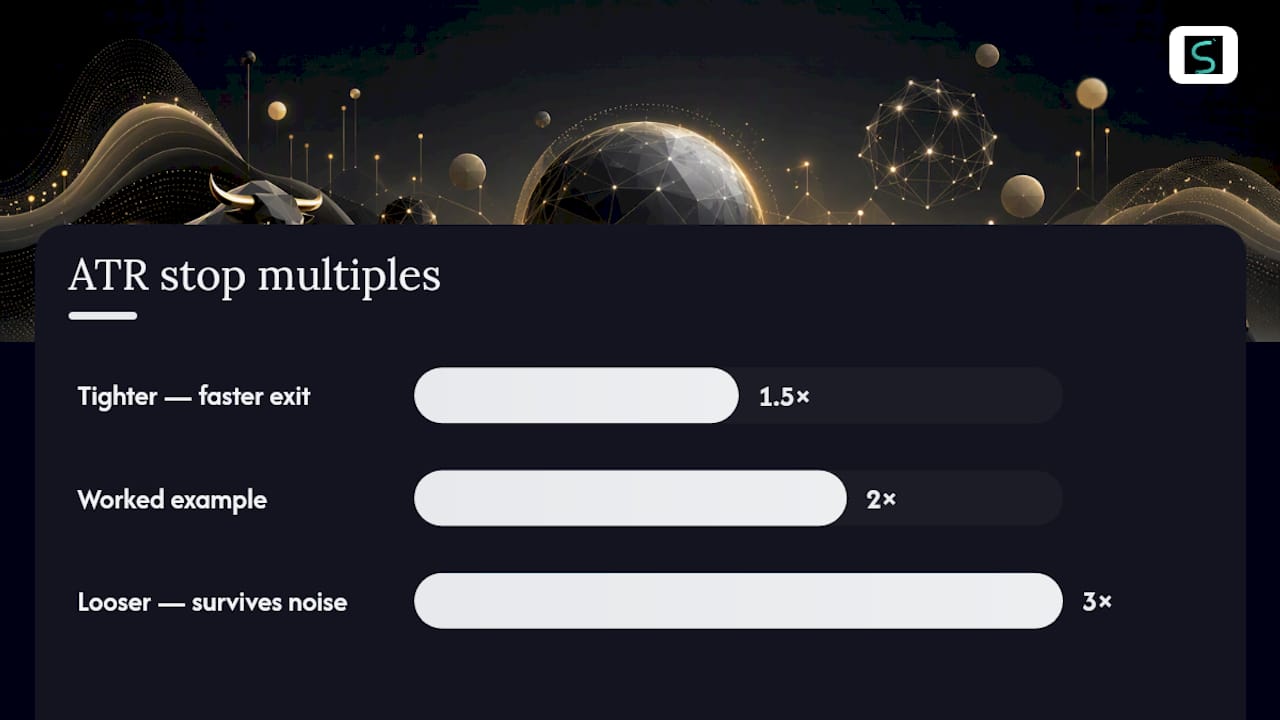
The most common stop formula in ATR-based systems is entry price minus a multiple of ATR, with multiples typically ranging from 1.5× to 3×. A tighter 1.5× multiple gets you out fast but eats more whipsaw losses in choppy stretches. A looser 3× multiple survives noise better but gives back more profit when a trade does reverse.
The Chandelier Exit takes this idea and makes it dynamic: instead of trailing from your entry price, it trails from the highest high (or lowest low) since entry, minus a multiple of ATR, usually 3×. As price extends in your favor, the stop ratchets up with it but never moves backward, locking in gains while still giving the trade room to breathe through normal pullbacks.
- Initial stop: Entry − (2 × ATR) for a long position
- Target: Entry + (3 × ATR), giving roughly 1.5:1 reward-to-risk before slippage
- Trail activation: once unrealized gain exceeds 1× ATR, switch to a Chandelier-style trailing stop
Position sizing follows directly from the stop distance: Size = (Risk in Dollars) / (Multiple × ATR). A worked example makes it concrete. Say your account risks $200 per trade, ATR(14) on the instrument reads $1.50, and you're using a 2× multiple. Your stop distance is $3.00, so your position size is $200 divided by $3.00, or roughly 66 shares. When ATR spikes during a news event, that same $200 risk buys you a smaller position automatically, which is exactly the point.
Academic testing on sector-level data found ATR-conditioned strategies reduced forecast error (MAPE) by roughly 28% compared to standard-deviation-based volatility measures, and produced higher average returns across the tested sectors.
Backtesting Your ATR Filter and the Pitfalls That Break It
A minimal backtest plan needs a defined market and timeframe, a minimum of 100 trades before you trust any conclusion, and a strict split between in-sample data used for tuning and out-of-sample data used only for verification. Walk-forward testing, where you retune on a rolling window and test forward on unseen bars, catches decay a single static backtest will miss entirely.
Track more than raw return. Max drawdown and the return-to-drawdown ratio tell you how the equity curve actually felt to trade, win rate and average R multiple tell you what kind of system you built, and stop-touch frequency tells you whether your ATR multiple is calibrated or arbitrary.
- Over-filtering: stacking too many ATR conditions on top of a trend filter and an entry trigger often kills the very edge you were trying to protect.
- Lookahead bias: using an ATR value calculated from a bar that hadn't closed yet when the signal fired, a subtle bug that inflates results dramatically.
- Microstructure noise: on 1-minute bars, ATR reacts to bid-ask bounce and thin liquidity as much as real volatility, producing filters that look great in backtest and fall apart live.
- Survivorship bias: testing only on symbols that happened to trend well historically and assuming the filter, not the symbol selection, drove the returns.
Combining a clean trend filter with a single, well-tested entry trigger tends to produce more stable backtest results than piling on additional indicators hoping one of them fixes a weak edge. Stress-test with Monte Carlo resampling of your trade sequence, split results by volatility regime to see if the edge only exists in one type of market, and rerun with slightly shifted parameters to confirm the strategy isn't a lucky accident of one specific setting.
How Scalping-Algo Supports ATR Filter Workflows
Building the rules card is one problem. Running it live, on multiple charts, without manually checking ATR% on every bar, is another. Scalping-Algo's open-source Pine Script v6 indicators expose adaptive ATR inputs directly on the chart, so the volatility gate from your rules card becomes a visible, adjustable setting rather than buried code.
The Command Center dashboard ties backtesting, alerts, and signals into one view, which matters when you're running the diagnostics from the tuning section above, stop-touch frequency, trade count, drawdown, without exporting data into a spreadsheet every time. Native webhook alerts push entry and exit conditions straight to Discord the moment the ATR gate and setup trigger both fire, closing the gap between a rule on paper and a rule executed on time. For readers building out the sizing and drawdown limits from the rules card, the risk management checklist walks through the same logic in more depth.
When ATR Is the Right Volatility Filter, and When It Isn't
ATR earns its place because it's simple, calculable on any timeframe, and empirically solid in heavy-tailed sectors where standard deviation gets skewed by outliers. But it's a blunt instrument for options traders, where implied-volatility percentile often carries more signal about whether to buy or sell premium. For news-sensitive trades, pair ATR with a regime measure rather than trusting it alone. The traders who stay profitable are the ones who keep a trade log and revisit their thresholds every quarter, not the ones who set it once and walk away.
— Tran
Get Your ATR Filter Rules Running Without Building From Scratch
Coding a rules card by hand, testing it bar by bar, then manually watching charts for the ATR gate to trigger works, but it's slow and error-prone compared to running it on tools built for exactly this job. Scalping-Algo's Smart Scalping Signals indicator bakes volatility gating and confluence checks directly into non-repainting, candle-close-confirmed signals, so the ATR gate from this rules card fires automatically instead of requiring a manual check every session.
Every script ships open-source, so you can see exactly how the ATR logic is implemented rather than trusting a black box. Pair it with Edge Finder for regime detection alongside your ATR gate, and route both to Discord through native webhook alerts for execution without staring at charts all day. Plans run monthly at $79 per month, yearly at $799, or lifetime at $1,999 for one-time access to the full suite. Check current indicator access and the Command Center dashboard on the Scalping-Algo site to get your rules card running today.
Sources
- ATR forecasting and economic value poster (BU project)
- ATR (Average True Range): Full Guide 2026 — TradingCompendium
- Average True Range (ATR) — TradingView support
- ATR Filter Strategy: 9 Rules + Free Download 2026 — BestMT4EA
FAQ
What Is an ATR Strategy and How Does It Work?
An ATR strategy uses the Average True Range to measure how much an instrument is moving, then gates entries so trades only fire during favorable volatility conditions. A typical setup pairs a trend filter and entry trigger with an ATR gate, such as ATR% above 1%, then sizes stops and positions off that same ATR reading.
What Is the Best Setting for ATR?
The most widely used default is a 14-period ATR, smoothed with RMA, which balances responsiveness against noise on most timeframes. Shorter periods like 7 react faster for scalping, while longer periods like 21 smooth things out for swing trading.
Is ATR Good for Day Trading?
Yes, ATR works well for day trading when you scale the threshold to the timeframe, since 1-minute or 5-minute charts naturally show smaller ATR% readings than daily charts. It's most useful paired with a trend filter, since ATR alone never signals direction.
What Is the Best ATR Period to Use?
There's no single best period, it depends on holding time. A 14-period ATR is the standard starting point across nearly every platform, and traders typically shift to 7 for faster intraday reaction or 21 for smoother swing-trade signals.
Does Scalping-Algo Include ATR-Based Volatility Filtering?
Yes, Scalping-Algo's indicator suite includes volatility gating built into its signal logic, along with backtesting tools to validate ATR-based rules before trading them live. Full plan pricing is listed on the Scalping-Algo site.