

A non-repainting signal is a trading indicator output that locks permanently once a candle closes, meaning it never recalculates or disappears from historical data. That single property separates trustworthy indicators from ones that create an illusion of accuracy. With non-repainting signals explained clearly, traders across crypto, forex, indices, and futures can make decisions based on what the market actually showed, not a revised version of it. The CFA Institute identifies look-ahead bias as one of the most damaging flaws in backtesting, and repainting indicators are its primary source. For short-term traders working on 1-minute to 15-minute timeframes, signal integrity is not optional.
What are non-repainting signals and how do they work?
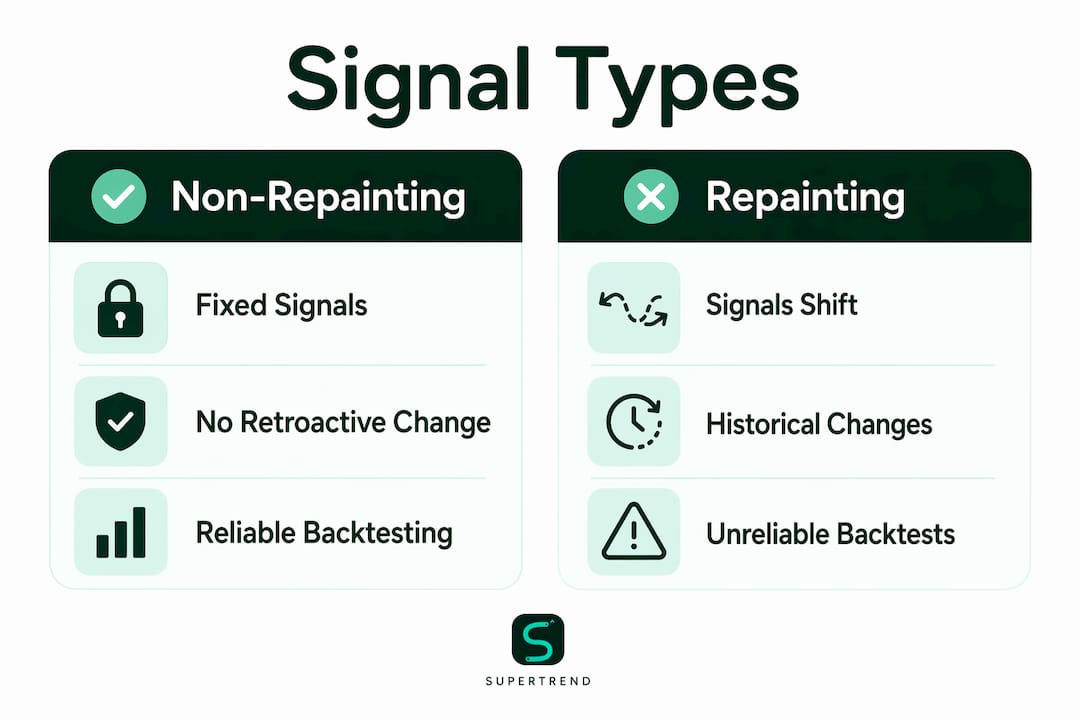
A non-repainting signal locks after candle close and does not recalculate retroactively. The value you see on bar 100 today will be identical on bar 100 six months from now. That consistency is what makes historical backtesting meaningful and live trading decisions trustworthy.
Repainting indicators work differently. They continuously recalculate as new price data arrives, which means a buy signal visible on a past bar may vanish or flip to a sell signal once the market moves forward. Traders reviewing their charts later see only the "correct" signals, creating a false impression of accuracy.
The mechanics behind non-repainting behavior come down to how an indicator reads its data buffer. A non-repainting indicator reads only confirmed, closed bar data. It never references the current, still-forming candle for its historical output. That design choice eliminates the possibility of retroactive changes.

Pro Tip: When evaluating any indicator, check whether its signals appear on the current live bar or only after the bar closes. Signals that appear mid-bar and then shift are the clearest sign of repainting behavior.
How do you test an indicator for repainting?
Testing for repainting is a straightforward process when you follow a structured method. Industry standard practice requires comparing indicator buffer screenshots at candle close with real-time views across multiple market conditions.
- Use bar replay mode. TradingView's bar replay tool lets you step through historical bars one at a time. Load your indicator, replay to a specific point, and record every signal. Then compare those signals to what the indicator shows on a normal chart view of the same period.
- Screenshot at candle close. Capture the indicator's output the moment each candle closes. Return to the same chart 24 hours later and compare. Any signal that moved, disappeared, or changed color has repainted.
- Test across market conditions. Run the same test during trending markets, ranging markets, and high-volatility events. Some indicators repaint only under specific conditions, so a single test environment gives an incomplete picture.
- Check the source code when available. Open-source Pine Script indicators on TradingView let you inspect the code directly. Look for functions that reference
barstate.islastor usesecurity()calls withlookahead=barmerge.lookahead_on. Either can introduce repainting. - Compare live alerts to chart history. If your indicator fires an alert in real time but the corresponding signal is absent from the chart the next day, the indicator repainted.
Pro traders recommend rigorous live and historical testing across multiple market conditions as the only reliable way to confirm signal trustworthiness. Skipping this step is the most common mistake traders make when adopting a new indicator.
Pro Tip: Run your bar replay test on at least three different market sessions, including one with a major news event. Repainting indicators often behave differently when volatility spikes.
Why do non-repainting indicators matter more than most traders realize?
The difference between a repainting and a non-repainting indicator is not just technical. It determines whether your backtest results reflect reality or fiction.
Look-ahead bias causes repainting indicators to use future price data, artificially inflating backtest performance. A strategy that appears to win 80% of the time on a repainting indicator may perform far worse in live conditions. The backtest looked perfect because the indicator already "knew" where price was going.
Not all repainting is deceptive, though. Functional repainting tools like ZigZag are valuable for post-move analysis but not for live trading signals. ZigZag needs future data to confirm pivot points, which is why it redraws as price continues. Traders who understand this use ZigZag for chart analysis after the fact, never for real-time entries.
"The most cynical marketing in trading software is selling repainting indicators as non-repainting for perfect historical results. Vendors exploit the trader's desire for a clean, winning chart by retroactively adjusting signals to match price moves. The chart looks flawless. The live account does not."
Deceptive repainting occurs when vendors sell indicators as non-repainting but the tool resignals historical data to create perfect past charts. This is a deliberate marketing tactic, not a technical limitation.
| Feature | Non-repainting indicators | Repainting indicators |
|---|---|---|
| Signal stability | Fixed after candle close | Changes as new data arrives |
| Backtest reliability | Reflects real conditions | Inflated by look-ahead bias |
| Live trading use | Directly applicable | Results may not match live |
| Functional use case | Entries, exits, alerts | Post-move analysis only |
| Transparency | Verifiable via replay | Often obscured in code |
Understanding trading signal accuracy standards helps traders evaluate any indicator against this framework before committing real capital.
What types of non-repainting indicators work best for scalping?
Short-term traders need indicators that confirm signals fast and hold those signals firm. Several categories of non-repainting indicators fit that requirement.
- Fixed buffer indicators. These calculate their output using only closed bar data and store the result in a fixed array position. The signal never changes once written. Moving average crossovers built on closed bars fall into this category.
- Delayed confirmation tools. These indicators wait for one or two additional bars to close before printing a signal. The delay eliminates ambiguity at the cost of a slightly later entry. For scalpers, this tradeoff is often worth it.
- Divergence detectors. When built correctly on closed bar data, divergence tools identify momentum shifts between price and an oscillator like RSI or MACD. These signals are particularly useful on 5-minute and 15-minute charts.
- Volatility-gated signals. These indicators only fire when market volatility meets a defined threshold, reducing false signals during low-volume periods. Scalping-algo's indicators use volatility gating as a built-in filter.
- Confluence tools. These combine multiple non-repainting conditions, such as trend direction, momentum, and volume, and only signal when all conditions align. Fewer signals, but higher quality.
Using Pine Script to build non-repainting indicators on TradingView gives traders full control over signal logic and transparency. Pine Script v6 in particular offers cleaner buffer management, which makes it easier to write indicators that hold their signals after candle close. Scalping-algo builds all its indicators in Pine Script v6 for exactly this reason.
The tradeoff with non-repainting indicators is entry timing. Because signals only confirm at candle close, you may enter slightly later than an indicator that signals mid-bar. That cost is real but predictable. A repainting indicator's cost is unpredictable and often invisible until you are already in a losing trade.
For traders working with oscillator-based signals, understanding which oscillators repaint and which do not is a prerequisite before building any short-term strategy around them.
How do you use non-repainting signals effectively in live trading?
Knowing how non-repainting signals work is only half the equation. Applying them correctly in live conditions is where most traders lose the edge they thought they had.
- Read signals only after candle close. Never act on a signal that appears mid-bar. Wait for the bar to close and the signal to lock. This single rule eliminates most false entries caused by premature signal reading.
- Integrate signals into a written trading plan. A signal is an input, not a decision. Your plan should define the conditions under which you act on a signal, including trend direction, session time, and risk parameters.
- Avoid overloading your chart. Using five non-repainting indicators that all measure momentum creates false confidence through redundancy. Choose indicators that measure different market dimensions: trend, momentum, and volatility.
- Track every signal in a trade journal. Log the signal, the entry, the exit, and the market context. After 50 trades, patterns emerge that no backtest can replicate.
- Combine signals with market context. A buy signal on a 5-minute chart carries more weight when the 15-minute chart shows a clear uptrend and volume is above average.
Reliable short-term scalping depends on verified non-repainting signals combined with contextual market analysis. The signal tells you when conditions align. Your judgment tells you whether the context supports acting on it.
Pro Tip: Set your chart to auto-refresh and use alerts that fire at candle close, not mid-bar. Most trading platforms support candle-close alert conditions. This removes the temptation to jump in early.
For a deeper look at reading and interpreting signals in real-time conditions, the practical guide to trading signals covers the full workflow from signal generation to execution.
Key Takeaways
Non-repainting signals are the foundation of any trustworthy short-term trading system because they reflect what the market actually showed, not a retroactively corrected version of it.
| Point | Details |
|---|---|
| Core definition | A non-repainting signal locks permanently after candle close and never recalculates retroactively. |
| Testing method | Use bar replay and candle-close screenshots to verify signal stability across multiple market conditions. |
| Repainting risk | Look-ahead bias from repainting indicators inflates backtest results and misleads live trading decisions. |
| Functional vs. deceptive | ZigZag-style tools repaint by design for analysis; deceptive repainting is a deliberate marketing tactic. |
| Best practice | Confirm signals only at candle close and combine them with trend, volatility, and session context. |
The honest truth about non-repainting signals
Traders often come to non-repainting indicators expecting a solution to losing trades. That expectation sets them up for disappointment. A non-repainting signal is a quality control standard, not a profit guarantee.
What I have found after years of working with short-term trading systems is that the value of a non-repainting indicator shows up most clearly in your backtesting. When your historical results are built on signals that actually existed at the time, your strategy development becomes grounded in reality. You stop chasing setups that never actually occurred.
The harder lesson is that even perfect signal integrity does not replace market judgment. A non-repainting buy signal on a 1-minute chart during a news spike is still a low-quality trade. The signal is real. The context is wrong. Traders who treat signals as commands rather than inputs consistently underperform those who treat them as one input among several.
My recommendation is to spend as much time testing your indicators as you spend learning to read them. Use the indicator reliability testing framework before you commit any indicator to a live strategy. The traders who skip that step are the ones who end up blaming their tools instead of their process.
— Tran
Scalping-algo's approach to verified signal performance
Scalping-algo builds every indicator in Pine Script v6 with non-repainting signal integrity as a non-negotiable design requirement. All scripts are open-source, so you can verify the signal logic yourself before trading with it.
The platform's premium scalping indicators cover crypto, forex, indices, commodities, and futures, with signals optimized for 1-minute to 15-minute timeframes. Volatility gating, divergence detection, and confluence filters are built in, not bolted on. The Algo Master three-indicator suite combines trend, momentum, and entry signals into one tested system. Every signal fires at candle close. Every output is verifiable in replay mode. That is the standard Scalping-algo holds itself to, and it is the same standard you should hold every indicator you use.
FAQ
What does non-repainting mean in trading?
A non-repainting indicator produces signals that remain fixed after a candle closes and never recalculate retroactively. This ensures that historical chart data matches what the indicator showed in real time.
How do I know if my indicator repaints?
Use bar replay mode to step through historical bars and record signals at candle close. Compare those recorded signals to what the indicator shows on a standard chart view of the same period. Any difference confirms repainting.
Why does repainting make backtests unreliable?
Repainting introduces look-ahead bias, meaning the indicator uses future price data to generate past signals. The CFA Institute identifies this as a primary cause of artificially inflated backtest performance metrics.
Is all repainting bad?
No. Functional repainting tools like ZigZag require future data to confirm pivot points and are designed for post-move analysis. The problem is deceptive repainting, where vendors market repainting indicators as non-repainting to show perfect historical results.
Can non-repainting signals work on short timeframes like 1-minute charts?
Yes. Non-repainting indicators built on closed bar data work on any timeframe, including 1-minute charts. The key is confirming signals only after each bar closes, not while the bar is still forming.