

Real-time signals are defined as market alerts delivered the moment a qualifying event is detected, with no delay between detection and delivery. The benefits of real-time signals go far beyond convenience. They determine whether you act on a trade setup or watch it disappear. Sub-10-second delivery via persistent WebSocket connections separates true real-time platforms from polling-based systems that leave traders 10 or more minutes behind the market. Scalping-algo builds every indicator around this principle: non-repainting signals on 1m–15m timeframes, designed so you see the setup when it still matters.
1. How faster signal delivery reduces latency for traders
Speed is the most direct benefit of real-time signals. Traditional polling checks for new data at fixed intervals, often every 15 minutes, meaning you could be a full quarter-hour behind a live market move. In scalping and high-frequency trading, that gap is not a minor inconvenience. It is the difference between a profitable entry and a missed trade.
Push-based delivery via WebSocket connections eliminates that gap. The signal fires the instant the system classifies an event as relevant, with no manual refresh and no batch queue. For scalpers working 1-minute or 5-minute charts, this matters on every single trade.
- Sub-10-second delivery: Signals reach your dashboard before the opportunity closes.
- Event-driven pipelines: Data pushes at detection, not on a timer.
- No manual refresh: You receive alerts passively, keeping focus on execution.
- Persistent connections: The channel stays open, so no signal gets dropped between polling cycles.
Pro Tip: Ask any platform vendor to show you their delivery architecture. If they cannot explain whether they use WebSocket push or HTTP polling, assume it is polling and factor in the latency accordingly.
2. What accuracy advantages do real-time signals offer?

Speed without accuracy creates noise, not edge. AI relevance filtering solves this by evaluating each signal against your specific portfolio and trading context within milliseconds. You receive only the alerts that match your setup criteria, not a flood of generic market noise.
This matters because alert fatigue is a real performance killer. When every notification demands attention, traders start ignoring them. A well-filtered signal feed keeps your attention on high-probability setups.
Key features that improve signal accuracy include:
- Contextual filters: Signals are scored against your asset class, timeframe, and volatility conditions.
- Client-specific relevance: Each trader receives a customized feed, not a broadcast.
- Signal classification: Alerts are categorized by type (breakout, divergence, confluence) so you know the setup before you look at the chart.
- False positive reduction: Irrelevant signals are suppressed before they reach your screen.
Scalping-algo applies volatility gating and divergence detection to every signal, which means the indicator only fires when market conditions actually support the setup. That cuts noise and builds confidence in each alert you act on.
3. How real-time signals build structural alpha over time
Structural alpha is the cumulative performance advantage that comes from consistently acting on better information faster than the market. A small time edge on thousands of events each year compounds into a measurable difference in annual returns. This is not theory. It is the arithmetic of repeated early action.
Think about it this way: if you capture even a fraction of a favorable move on each signal, and you receive hundreds of those signals per month, the aggregate gain separates you from traders using delayed data. Companies with strong real-time capabilities achieve over 50% higher revenue growth and net margins than peers relying on batch data. The same principle applies to individual traders.
The goal of real-time architecture is to prevent you from being the last to know about a material market event. Defensive positioning requires early information, not confirmation after the move.
Pro Tip: Track your signal-to-execution time over 30 days. If you consistently act within seconds of a signal, you are capturing structural alpha. If you are acting minutes later, the edge is already gone.
4. What operational and risk management benefits do real-time signals bring?
Risk management is where delayed signals cause the most damage. Delays of even a few seconds can result in financial losses or compliance failures in high-frequency workflows. Real-time alerts give you the window to act before a bad position gets worse.
Institutions can evaluate transactions within 200 milliseconds to block suspicious activity before completion. That same speed principle applies to position management: a real-time alert on a volatility spike lets you close or hedge before the move fully develops.
The operational sequence looks like this:
- Signal fires: The system detects a qualifying market event and pushes the alert instantly.
- Trader receives alert: Delivery via webhook to Discord or dashboard takes under 10 seconds.
- Position assessed: You evaluate open exposure against the new market condition.
- Decision executed: You adjust, exit, or hold based on current data, not data from 15 minutes ago.
- Risk log updated: The event is recorded for review, supporting consistent process improvement.
Scalping-algo's native webhook alerts to Discord follow exactly this sequence. The alert reaches you in real time, so step three and four happen while the opportunity or threat is still live. Understanding why financial processing delays exist in traditional systems makes the contrast with real-time trading infrastructure even clearer.
5. How to evaluate real-time signal platforms effectively
Not every platform that claims real-time delivery actually provides it. Most platforms labeled as real-time use polling with delays up to 30 minutes. True real-time requires persistent WebSocket connections and event-driven push delivery. This distinction is the first thing to verify before committing to any platform.
| Feature | What to look for | Red flag |
|---|---|---|
| Delivery method | WebSocket push | HTTP polling or "near real-time" |
| Signal latency | Under 10 seconds | No latency data published |
| Relevance filtering | AI or rule-based customization | Generic broadcast to all users |
| Alert customization | Webhook, email, in-app options | Single delivery channel only |
| Transparency | Open-source or auditable logic | Black-box signal generation |
Selecting real-time platforms requires balancing delivery speed, accuracy, alert customization, and cost complexity. For scalpers and high-frequency traders, the cost of real-time infrastructure is justified. For swing traders operating on daily charts, the urgency is lower and the cost-benefit calculation changes.
Scalping-algo publishes open-source Pine Script v6 code for all indicators. You can read the logic, verify the signal conditions, and confirm there is no repainting. That level of transparency is the standard you should demand from any platform you trust with live trade decisions.
Pro Tip: Run any platform in paper trading mode for two weeks and log every signal with a timestamp. Compare signal time to the actual candle that triggered it. If there is consistent lag, the platform is polling, not pushing.
6. Why real-time signals support better decision-making at every level
Real-time data empowers traders to act quickly, reducing errors that come from stale information and hierarchical approval delays. This applies whether you are a new trader learning to read setups or an experienced scalper executing dozens of trades per session.
For newer traders, real-time signals remove the guesswork about timing. The alert tells you when the setup is live, so you focus on execution rather than chart-watching. For experienced traders, the advantage is speed and consistency. You do not miss setups because you were watching a different chart. The signal finds you.
The real-time signal applications that matter most are those tied to your specific trading style. A scalper on a 1-minute Bitcoin chart needs sub-second awareness of momentum shifts. A forex trader on a 15-minute EUR/USD chart needs confluence confirmation before entry. Both benefit from real-time trading signals that match their timeframe and asset class, not a one-size-fits-all alert feed.
7. How real-time alerts integrate with automated trading systems
Automation multiplies the value of real-time signals. A signal that fires and routes through a webhook to an automated execution system removes human reaction time from the equation entirely. The role of automation in financial markets is precisely this: converting a real-time signal into a real-time order without the delay of manual input.
Scalping-algo's Command Center integrates alerts, backtesting, and signal delivery in one dashboard. Webhook alerts route directly to Discord, where automated bots can trigger order execution on connected broker APIs. This creates a closed loop: signal detected, alert pushed, order placed, all within seconds.
The practical implication is that real-time market data becomes most powerful when paired with a system that can act on it without waiting for you to click. For scalpers especially, this is not a luxury. It is the architecture that makes the strategy viable at scale.
Key takeaways
Real-time signals deliver their full advantage only when speed, accuracy, and execution infrastructure work together as a complete system.
| Point | Details |
|---|---|
| Speed defines the edge | Sub-10-second push delivery via WebSocket separates real-time from polling-based platforms. |
| Accuracy requires filtering | AI relevance filtering cuts noise and delivers only signals matched to your portfolio and timeframe. |
| Structural alpha compounds | A small time edge on thousands of annual events accumulates into measurable long-term performance gains. |
| Risk control depends on timing | Real-time alerts let you manage open positions and respond to volatility before delayed data traders can react. |
| Transparency is non-negotiable | Platforms with open-source or auditable signal logic give you the verification that black-box systems cannot. |
Why most traders underestimate the real-time signal advantage
I have watched traders spend weeks debating indicator settings while running on a polling-based platform that delivers signals 15 minutes late. The indicator settings are almost irrelevant at that point. You are trading yesterday's setup with today's risk.
The misconception I see most often is that real-time means "fast enough." It does not. Real-time means the signal arrives before the opportunity closes. For a scalper on a 1-minute chart, that window can be 30 seconds. A platform polling every 15 minutes is not in the same category.
The second mistake is treating real-time signals as a passive tool. The technology only creates advantage if your workflow is built to act on it. That means pre-defined entry criteria, a clear risk rule, and an execution process that takes seconds, not minutes. Real-time alerts are the trigger. Your process is the weapon.
The traders I have seen build consistent edge are not the ones with the most complex indicators. They are the ones who receive clean, fast signals and execute the same way every time. Real-time infrastructure makes that repeatability possible. Everything else is refinement.
— Tran
Scalping-algo's real-time indicators: built for the edge you need
Scalping-algo's premium TradingView indicators deliver everything covered in this article: sub-10-second signal delivery, non-repainting buy and sell alerts, volatility gating, and native webhook integration for Discord-based execution.
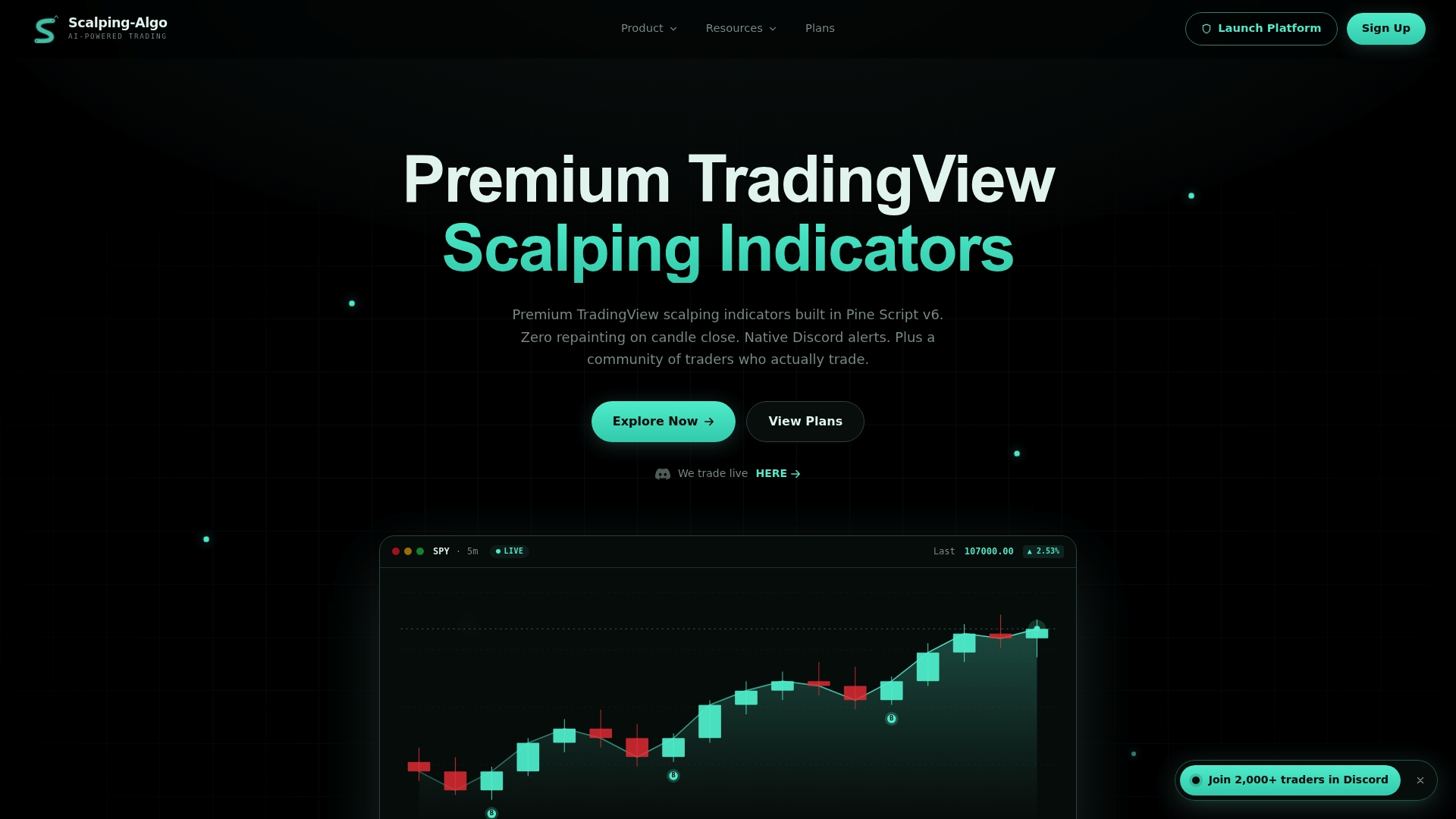
Every indicator runs on Pine Script v6 with open-source code you can read and verify. The Algo Master suite combines three indicators into one integrated system covering entries, confluence, and divergence detection across crypto, forex, indices, and futures. Whether you are new to scalping or running an active trading desk, the tools are built to match your speed. Visit Scalping-algo to see the full indicator lineup and start trading with signals that actually arrive in time.
FAQ
What are the main benefits of real-time signals for traders?
Real-time signals deliver market alerts the moment a qualifying event is detected, giving traders the speed advantage needed to act before opportunities close. The core benefits include faster execution, reduced latency, accurate filtering, and better risk management.
How is real-time signal delivery different from polling?
True real-time delivery uses persistent WebSocket connections to push signals instantly upon detection. Polling checks for new data at fixed intervals, often every 15 minutes, leaving traders significantly behind live market conditions.
What is structural alpha and how do real-time signals create it?
Structural alpha is the cumulative performance advantage built by consistently acting on better information faster than the market. A small time edge repeated across thousands of annual trading events compounds into measurable long-term gains.
How do real-time signals help with risk management?
Real-time alerts notify traders of volatility spikes, margin exposure, and adverse price moves the moment they occur. This window allows position adjustments before delayed-data traders even receive the signal.
What should traders look for when evaluating a real-time signal platform?
Verify that the platform uses WebSocket push delivery, not polling. Look for AI-based relevance filtering, alert customization via webhook, and transparent or auditable signal logic before committing to any platform.