

These six traders tips will cut your losses and sharpen your execution within one week: risk 1% per trade, document your plan, set stops before entry, journal every trade, use entry/exit checklists, and test any automation in demo before going live.
Here is the one-action version of each:
- Risk 1% per trade. Open a spreadsheet right now and calculate your max dollar loss per trade based on your account size.
- Document your plan. Write your markets, session hours, and setup criteria in a single page you can read in 60 seconds.
- Set stops before entry. Define your stop distance before you click buy or sell. No exceptions.
- Journal every trade. Log date, instrument, setup type, entry, stop, result, and emotional state after every close.
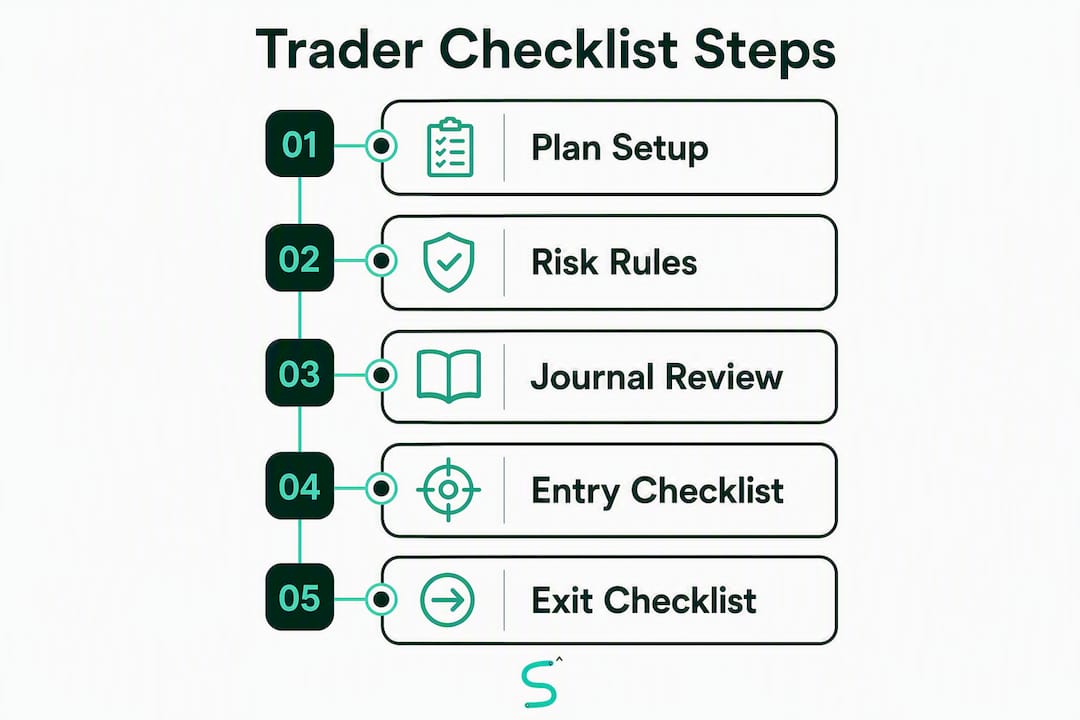
- Use entry/exit checklists. Build a five-point checklist and run it before every order.
- Test automation in demo first. Run any new indicator or bot for at least two weeks on a paper account before touching live capital.
Research consistently shows that roughly 13% of day traders maintain consistent profitability over six months, and only about 1% do so over five years. That gap exists almost entirely because of risk control and process, not signal quality. The tips below are ordered by survival priority, not popularity.
This article is general information, not financial advice. Confirm all rules with a qualified professional or primary regulatory source before trading.
Table of Contents
- Top traders tips you can apply this week
- How to build a compact trading plan and risk rules you will actually follow
- How to keep a trading journal that actually improves performance
- Create entry and exit checklists that stop impulsive trades
- How to test indicators and automation safely
- Common trader mistakes and the concrete fixes that stop them
- How much capital to start with as a retail trader
- Why overtrading and revenge trading destroy accounts faster than bad signals
- How alerts and technology help you trade less and capture more
- Psychological discipline techniques that keep emotions out of your trades
- How to stay educated and keep up with market news without losing focus
- Diversification strategies that protect your capital from volatility
- Key Takeaways
- What short-timeframe trading taught me about survival
- Scalping-algo brings institutional-grade tools to retail execution
- Useful sources and references
Top traders tips you can apply this week
Prioritized by impact on survival and consistency. Each tip includes a short rationale and three steps to implement before next Monday.

1. Risk no more than 1% per trade
Most retail accounts blow up not from bad signals but from oversized positions. The 1% rule keeps any single loss from doing permanent damage to your capital base.
- Calculate 1% of your current account balance and write it down as your max loss per trade.
- Set your position size by dividing that dollar amount by your stop distance in points or pips.
- Never override this calculation because a setup "looks strong."
2. Build a one-page trading plan
A trading strategy must define your markets, entry and exit rules, and money management before you place a single live trade. Without it, every decision is improvised.
- Write your markets, session hours, and two to three setup types on a single page.
- Add your risk per trade, daily loss limit, and a one-line mission statement.
- Print it or pin it to your screen. Read it before every session.
3. Set stops before entry, never after
Define your stop-loss and take-profit levels before entering a trade. Moving a stop further away once price moves against you turns a manageable loss into a catastrophic one.
- Identify your stop level on the chart before you size the position.
- Enter the stop order simultaneously with your entry order.
- Write a rule in your plan: "Stop placement never changes after entry."
4. Keep a trading journal
A comprehensive trading journal is the most critical tool for serious retail traders to spot emotional mistakes and refine strategy from real performance data.
- Log every trade: date, instrument, timeframe, setup, entry, stop, size, result, and emotional state.
- Review your journal every Sunday for 30 minutes.
- Flag any trade where you deviated from your plan and write one sentence on why.
Pro Tip: Track your "deviation rate" — the percentage of trades where you broke a rule. Cutting that number in half has more impact on profitability than finding a better indicator.
5. Use entry and exit checklists
Impulsive entries are the single biggest source of avoidable losses. A five-point checklist takes 20 seconds and removes the emotion from the decision.
- Build a checklist: market condition, confluence, order size, stop placed, R:R confirmed.
- Run it before every single entry, including "obvious" ones.
- Add an exit checklist: TP level, partial scale-out rule, trailing stop trigger.
6. Test before you trade live
Demo testing reduces the chance of large losses while you learn execution timing. No strategy deserves live capital until it has survived at least two weeks of forward testing.
- Run every new setup or indicator in a paper account for a minimum of two weeks.
- Log demo results in the same journal format as live trades.
- Only graduate to live trading when the demo results match your plan's expectations.
7. Use price action as your foundation
Price action is a more reliable foundation than stacking indicators. Indicators confirm what price is already telling you; they do not replace reading the chart.
- Identify key support, resistance, and order block levels before adding any indicator.
- Use indicators to confirm, not initiate, a trade idea.
- Remove any indicator you cannot explain in one sentence.
How to build a compact trading plan and risk rules you will actually follow
A trading plan does not need to be long. It needs to be specific enough that you can follow it under pressure. Here is a minimal template:
| Element | Example |
|---|---|
| Markets | ES futures, EUR/USD, BTC/USD |
| Session hours | 9:30–11:30 AM ET, 2:00–4:00 PM ET |
| Setup types | Breakout retest, order block bounce |
| Risk per trade | 1% of account |
| Daily loss limit | 2% of account (stop trading for the day) |
| Mission statement | Protect capital first, grow it second |
Position sizing formula: Divide your max dollar risk per trade by your stop distance in points or pips. If your account is $10,000, your 1% risk is $100. If your stop is 10 pips and each pip is worth $1, your position size is 10 units. This formula links every trade directly to your risk management rules.
Stop-loss discipline comes down to three rules:
- Define the stop level on the chart before calculating position size.
- Never widen a stop once the trade is live. Tighten or close; never expand.
- Move to breakeven only after price has moved at least 1R in your favor.
Set a daily loss limit and honor it without negotiation. Discipline on daily loss limits prevents cascade failures from revenge trading. When you hit your daily limit, close the platform and step away.
Pre-trade checklist (paste into your journal or order screen):
- Setup matches plan criteria
- Stop level identified on chart
- Position size calculated from risk %
- R:R is at least 1:1.5
- Daily loss limit not yet reached
How to keep a trading journal that actually improves performance
A journal is only useful if you review it. Logging trades without a weekly review is just record-keeping. The combination of logging and structured review is what drives real performance improvement.

Core journal fields to track for every trade:
| Field | What to log |
|---|---|
| Date & time | Entry timestamp |
| Instrument | Ticker or pair |
| Timeframe | Chart timeframe used |
| Setup type | Named setup from your plan |
| Entry price | Exact fill |
| Stop price | Pre-defined level |
| Position size | Units or contracts |
| R:R | Planned ratio |
| Result | P/L in dollars and R |
| Emotional state | Calm / anxious / impulsive |
| Plan deviation | Yes / No — describe if yes |
Weekly review routine (30–60 minutes every Sunday):
- Calculate win rate by setup type and average R per setup.
- Identify the two setups with the worst average R and flag them for review.
- Count plan deviations. If more than 20% of trades had a deviation, that is your priority fix.
- Write two experiment actions for the coming week (e.g., "Only trade setup A during the first hour").
Review checklist to catch recurring rule breaks:
- Did I move any stops further away?
- Did I take a trade to "make back" a loss?
- Did I trade more than my planned number of setups?
- Did I enter without running my checklist?
Create entry and exit checklists that stop impulsive trades
Checklists work because they force a pause. That pause is where discipline lives. Here are two templates you can copy today.
Entry checklist (scalping and short-term setups):
- Market is in a tradeable condition (trending or ranging as defined in plan)
- Liquidity is adequate for your timeframe (avoid first 5 minutes of session open for most setups)
- At least two confluence factors align (e.g., order block + indicator signal)
- Position size calculated and within risk rules
- Stop level placed on chart before order entry
- R:R is at least 1:1.5
- Entry trigger confirmed (candle close, breakout, or signal)
For advanced entry methods on scalping setups, the same checklist applies with tighter timeframe filters.
Exit checklist:
- Fixed TP level hit: close full or partial position per plan
- Partial scale-out: close 50% at 1R, trail remainder
- Trailing stop: activate after 1.5R, trail by ATR or structure
- Event-driven exit: close before scheduled news if holding through it violates plan
- Time-based exit: close any open position before session end if plan requires it
Successful scalpers take trades only when indicators align with price action zones such as support, resistance, and order blocks, rather than acting on a single alert. That confluence requirement belongs in your entry checklist as a hard gate, not a suggestion.
How to test indicators and automation safely
The workflow is always the same: hypothesis, backtest on out-of-sample data, demo forward-test, then small live rollout with hard caps.
Step-by-step testing workflow:
- Form a hypothesis. Write one sentence: "This setup produces a positive expectancy on EUR/USD 5-minute charts during the London session."
- Backtest on out-of-sample data. Use data your indicator was not optimized on. Over-optimizing settings on historical data produces strategies that fail in live markets. Keep parameters simple.
- Run a walk-forward test. Divide your data into segments and test each one separately. If results collapse in any segment, the setup is not robust.
- Demo forward-test for at least two weeks. Log every signal and result in your journal.
- Small live rollout. Start with 25% of your intended position size. Set a daily max trade count and a dollar loss cap.
- Monitor and review. Check webhook reliability, signal timing, and fill quality. Build in a kill-switch: if the system hits a predefined drawdown, it stops automatically.
Automation safety checklist:
- Signals are non-repainting (confirmed on historical bars)
- Webhook alerts tested and confirmed before live use
- Connection redundancy in place (backup internet or VPS)
- Daily max trade count set
- Dollar loss cap per session set
- Kill-switch or manual override available at all times
Use automation to reduce screen time, but design it with kill-switches, caps, and monitoring to prevent runaway losses in volatile conditions.
Pro Tip: Overfitting is invisible until it costs you money. If your backtest win rate is above 70% on a short-term setup, treat it as a red flag, not a green light. Real edge in liquid markets is usually modest. Test for robustness, not perfection.
The SEC recommends independent verification of any trading system or provider. Before using any automation vendor, confirm they document their strategy, fees, and backtests clearly.
Common trader mistakes and the concrete fixes that stop them
| Mistake | Immediate fix |
|---|---|
| Moving stops further away | Write "stops never widen" in your plan; make it a hard rule |
| Revenge trading after a loss | Set a 24-hour cooling-off rule after hitting daily loss limit |
| Overtrading (too many setups) | Cap daily trades at a fixed number in your plan |
| Indicator overload | Remove all but two to three indicators; use them for confluence only |
| Ignoring transaction costs | Log commissions and spreads in every journal entry |
| Skipping the checklist on "obvious" trades | No checklist = no trade. No exceptions |
Prevention beats punishment. Build systems that stop bad habits before they start:
- Set a price alert for your daily loss limit in your broker platform so you get a notification before you hit it.
- Pre-commit in writing: "If I take a revenge trade, I close the platform for the rest of the day."
- Use a demo account for any new setup until it has at least 20 logged trades.
- Review common scalping mistakes regularly to catch patterns before they become habits.
Treat every loss as a fixed business expense. Codify a cooling-off rule that forces a journal review after any predefined loss event. That review, not the loss itself, is where improvement happens.
How much capital to start with as a retail trader
Starting small is not a limitation. It is a strategy. Trading with capital you can afford to lose while you build process is how you stay in the game long enough to get good.
For most retail traders in the U.S., a practical starting point is an account size that lets you risk 1% per trade while still having meaningful position sizes on your chosen instrument. On futures, that often means starting with one micro contract. On forex, a mini lot. On stocks, a small number of shares sized to your stop distance.
The goal in the first three to six months is not profit. It is proving that your process works: your plan is followed, your journal is complete, and your deviation rate is low. Capital grows when process is consistent. Rushing to trade larger before the process is proven is the most common way retail accounts fail.
Why overtrading and revenge trading destroy accounts faster than bad signals
Overtrading and revenge trading are not personality flaws. They are predictable responses to loss that every trader faces. The fix is structural, not motivational.
Overtrading happens when you have no daily trade cap. The fix is simple: write a maximum number of trades per session into your plan and treat it as a hard limit, not a guideline. When you hit the cap, the session is over regardless of what the market does.
Revenge trading follows a loss and is driven by the need to recover it immediately. The 24-hour cooling-off rule breaks this cycle. After hitting your daily loss limit, close the platform. Log the trades. Review the journal. Come back tomorrow.
Trade-chasing, entering a move after it has already started because you missed the setup, is overtrading's close relative. If you missed the entry trigger on your checklist, the trade does not exist. There will be another setup. Missing one is not a problem. Chasing it is.
How alerts and technology help you trade less and capture more
Sitting in front of charts for eight hours does not make you a better trader. It makes you a tired one. Alerts and automation let you define your criteria in advance and get notified when the market meets them, rather than watching for it manually.
Most broker platforms and TradingView support price alerts, indicator-based alerts, and webhook notifications. Set alerts at your key levels before the session starts. When an alert fires, run your checklist. If the setup qualifies, take it. If it does not, ignore it.
For short-term strategies, alerts on volatility conditions and session overlaps are especially useful because the best setups cluster around specific times and price levels. Automating the notification removes the need to watch continuously.
The key discipline: alerts tell you when to look, not when to trade. The checklist still runs every time.
Psychological discipline techniques that keep emotions out of your trades
Trading psychology is not about eliminating emotion. It is about building systems that prevent emotion from making decisions.
Three techniques that work in practice:
Pre-session routine. Spend five minutes before each session reviewing your plan, your daily loss limit, and your last three journal entries. This primes your decision-making before the market opens.
The "one trade at a time" rule. After any loss, close the chart for five minutes before looking at the next setup. This interrupts the emotional momentum that leads to revenge trades.
Post-session debrief. Rate your emotional state for the session on a 1–5 scale and log it in your journal. Over time, you will see a clear correlation between emotional state and deviation rate. That data is more useful than any indicator.
Trading is primarily a discipline and psychology game. Even advanced technical tools fail without emotional regulation and processes that prevent revenge trading and overtrading. The traders who survive long-term are not the ones with the best signals. They are the ones who follow their rules when it is hardest.
How to stay educated and keep up with market news without losing focus
Ongoing education matters, but undirected consumption of market content is a trap. The goal is structured learning that improves your specific edge, not general market awareness for its own sake.
Practical approach:
- Follow one or two primary sources for macro news relevant to your markets (Fed announcements, earnings calendars, economic data releases). Use an economic calendar daily.
- Spend 30 minutes per week reading about one specific topic related to your setup types (e.g., order flow, volatility, session behavior).
- Review your journal data monthly to identify which market conditions your setups perform best in. That data is your most relevant education.
- Use FINRA's investor resources to vet any new service, course, or provider before paying for it.
Avoid the trap of constantly switching strategies because of something you read. New information should be tested in demo before it changes your live trading approach.
Diversification strategies that protect your capital from volatility
Diversification for active traders is not the same as diversification for long-term investors. You are not building a portfolio. You are managing correlated risk across your active positions.
The practical rules:
- Do not hold multiple positions in highly correlated instruments at the same time (e.g., long EUR/USD and long GBP/USD simultaneously doubles your dollar exposure).
- Spread your trading across asset classes with low correlation: one forex pair, one equity index, one commodity or crypto position, each sized independently to your 1% risk rule.
- Vary your timeframes across setups. A 5-minute scalp and a 1-hour swing trade in different instruments are genuinely uncorrelated.
- Keep a portion of your account in cash or low-risk instruments. Active trading capital should not be 100% of your investable assets.
Volatility gating is a related concept: only trade when volatility conditions match your setup's requirements. Trading during extreme volatility without adjusting position size is the opposite of diversification.
Key Takeaways
Consistent trading performance comes from risk-first habits, a documented plan, and a weekly journal review — not from finding a better signal.
| Point | Details |
|---|---|
| Risk 1% per trade | Calculate your max dollar loss per trade before every session and size positions accordingly. |
| Document and follow your plan | A one-page plan with markets, setups, and daily loss limit removes in-session guessing. |
| Journal and review weekly | Log every trade and run a 30-minute Sunday review to catch deviations and refine setups. |
| Test before live capital | Run every new setup or indicator in demo for at least two weeks before going live. |
| Scalping-algo for execution | Scalping-algo's non-repainting indicators, backtesting dashboard, and webhook alerts support the phased testing workflow described in this article. |
What short-timeframe trading taught me about survival
The conventional wisdom says better signals lead to better results. After working with short-timeframe traders across crypto, forex, and futures, the evidence points somewhere else entirely.
The traders who last are not the ones with the most sophisticated indicators. They are the ones who treat risk management as non-negotiable and review their journal every single week without skipping. The 1% rule sounds conservative until you watch an account survive a five-trade losing streak intact while an unsized account loses 30% on the same sequence.
There is also a widely underestimated cost to indicator overload. Adding a fourth or fifth indicator to a chart does not add information. It adds noise and decision latency. The traders who perform most consistently tend to use two or three tools that confirm price action at key levels, not a dashboard full of signals competing for attention. Using indicators as confluence tools rather than primary signals is a discipline, not a limitation.
The one-week implementation plan in this article is not a shortcut. It is a minimum viable process. Apply it consistently for 30 days and your journal will show you exactly where your edge is and where your leaks are. That data is worth more than any course or signal service.
Scalping-algo brings institutional-grade tools to retail execution
Traders who want to apply the phased testing workflow in this article without building every tool from scratch have a practical option in Scalping-algo's indicator suite. The platform's TradingView indicators are non-repainting, built in Pine Script v6, and generate real-time buy and sell signals optimized for 1m–15m timeframes across crypto, forex, indices, commodities, and futures.
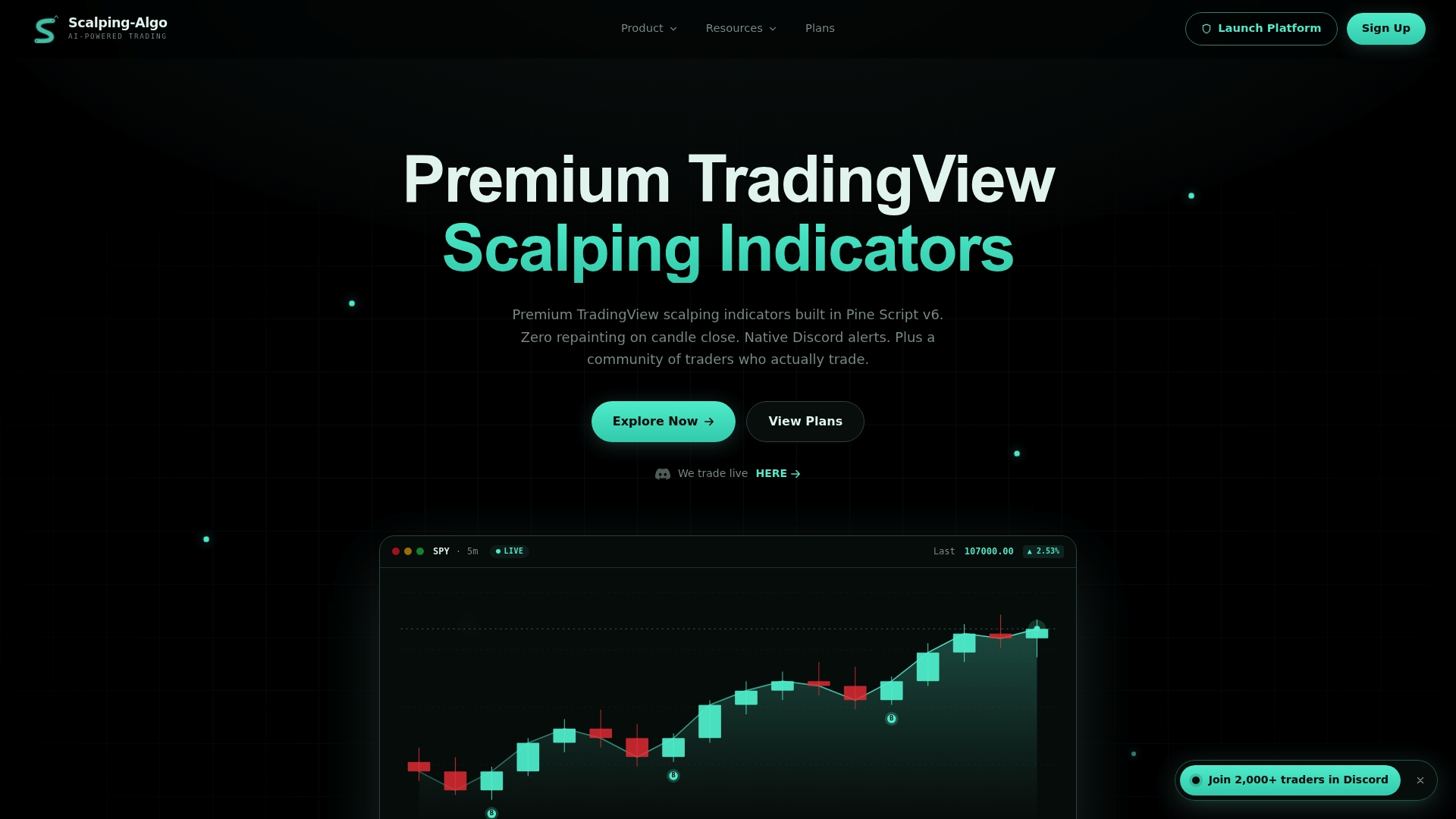
The backtesting dashboard and Command Center let you run the hypothesis-to-demo workflow described in the testing section without switching between platforms. Webhook alerts push signals directly to Discord, so you can set your criteria, step away from the screen, and get notified when a setup fires. All scripts are open-source, which means you can verify exactly what the logic does before trusting it with live capital.
For traders who want to see the full three-indicator system in action, the Algo Master page walks through how the suite is used in live trading. To explore the full indicator suite and membership options, visit Scalping-algo.
Useful sources and references
- SEC — Guidance on picking a broker or investment adviser: regulatory guidance on verifying providers, checking fees, and avoiding unnecessary trading.
- FINRA — Working with an investment professional: independent verification steps for any trading service or adviser.
- Investopedia — How to start day trading: foundational guidance on stop-loss discipline and entry/exit rules.
- Investopedia — Trading strategies overview: definitions and evaluation frameworks for common trading strategy types.
- Wikipedia — Trading strategy: standard definitions for strategy components and out-of-sample testing methods.
- Scalping-algo blog — Risk management checklist: compact risk checklist for position sizing and plan building.
- Scalping-algo blog — Short-term strategies guide: stop-loss and take-profit planning for retail traders.