

A futures contract is defined as a legally binding, standardized agreement to buy or sell a specific asset at a fixed price on a predetermined future date. Regulated by the Commodity Futures Trading Commission (CFTC) and overseen by the National Futures Association (NFA), these contracts trade on centralized exchanges and cover everything from crude oil to stock indices. Understanding what is a futures contract gives you a real edge, whether you plan to hedge risk or speculate on price direction. This guide covers the mechanics, types, uses, and key risks every trader needs to know before placing a single order.
What is a futures contract and how does it work?
Futures contracts are standardized by the exchange to specify the underlying asset, contract size, expiration date, and settlement method. That standardization is what makes futures liquid and transparent. Every buyer and seller knows exactly what they are agreeing to before the trade executes.
The core mechanics break down into a few key components:
- Underlying asset: The commodity, index, currency, or financial instrument the contract covers.
- Contract size: The exact quantity of the asset per contract (for example, 1,000 barrels of crude oil or 50 units of the S&P 500 index).
- Expiration date: The date on which the contract settles, either through physical delivery or cash payment.
- Settlement method: Cash settlement credits or debits the price difference; physical delivery transfers the actual asset.
- Margin: A good-faith deposit required to open and hold a position.
Margin requirements for futures typically range between 3% and 12% of the contract's total notional value. That means you control a large position with a fraction of its full cost, which amplifies both gains and losses.
Futures contracts are also marked to market daily, meaning gains and losses are credited or debited to your account at the end of every trading session. This daily reconciliation keeps risk transparent and prevents large hidden losses from building up unnoticed.
Pro Tip: Know your instrument's tick size before you trade. The tick size and value vary by contract, and one tick in the wrong direction can cost more than beginners expect. Calculate your dollar risk per tick before sizing any position.
What types of futures contracts exist?
Futures contracts cover a wide range of asset classes. Each class serves different traders and different purposes.
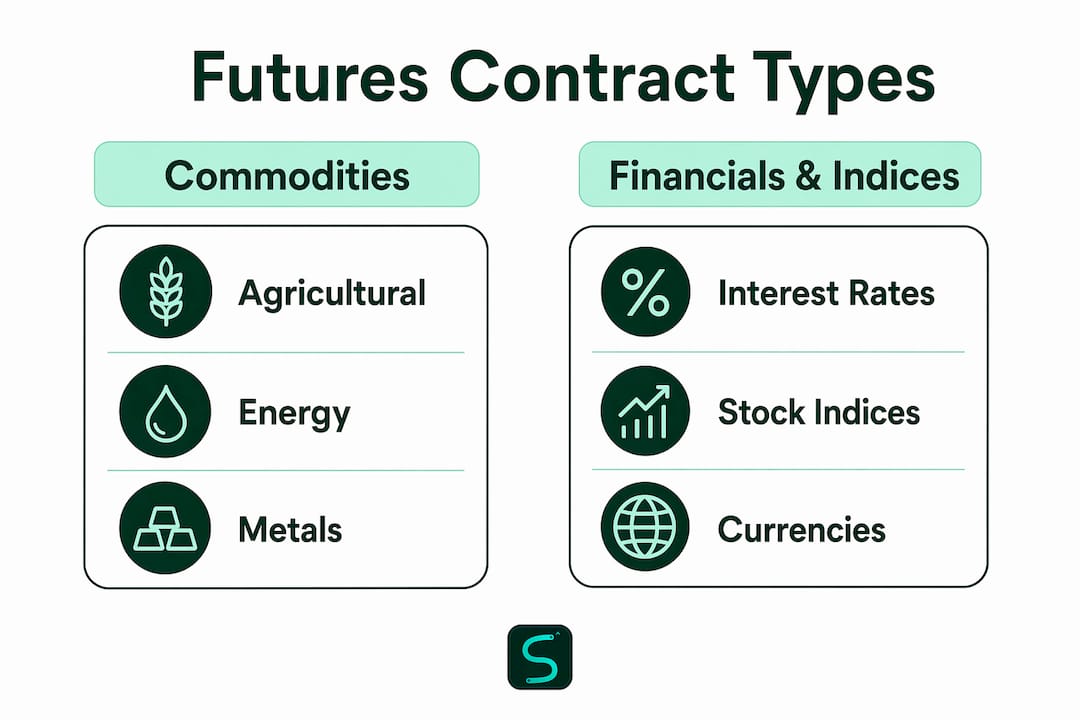
The four main categories are commodities, financials, indices, and currencies. Commodity futures include agricultural products like corn and wheat, energy products like crude oil and natural gas, and metals like gold and silver. Financial futures cover Treasury bonds and interest rate products. Index futures track benchmarks like the S&P 500, Nasdaq 100, and Dow Jones Industrial Average. Currency futures let traders speculate on or hedge against exchange rate movements between major pairs.
Beyond asset class, contract size matters enormously for retail traders. Standard contracts carry large notional values and require significant margin. Micro futures contracts offer one-tenth the size and margin requirements of standard contracts, making them far more accessible for smaller accounts. A micro E-mini S&P 500 contract, for example, controls one-tenth of what the standard E-mini controls.
| Contract type | Underlying asset | Settlement | Typical use |
|---|---|---|---|
| Commodity futures | Crude oil, gold, corn | Physical or cash | Hedging, speculation |
| Index futures | S&P 500, Nasdaq 100 | Cash only | Speculation, portfolio hedging |
| Currency futures | EUR/USD, GBP/USD | Physical or cash | Forex hedging, speculation |
| Micro futures | Scaled-down versions | Cash or physical | Beginner access, small accounts |
| Interest rate futures | Treasury bonds, fed funds | Cash | Rate hedging, institutional use |
Cash settlement is the more common outcome for retail traders. Physical delivery applies mainly to commodity producers and commercial buyers who actually need the underlying asset.
Why do traders use futures? Hedging vs. speculation
Futures markets exist for two distinct groups: hedgers and speculators. Both are necessary for the market to function.
Hedgers use futures to manage price risk on assets they already own or plan to buy. An airline, for example, locks in a fuel price months in advance to protect its operating budget from a spike in crude oil. A wheat farmer sells futures contracts before harvest to guarantee a sale price regardless of what the market does by delivery time. The futures contract transfers the price risk to someone else willing to accept it.
Speculators take the other side. They have no interest in the underlying asset. Their goal is to profit from price movements by going long when they expect prices to rise or short when they expect prices to fall. Speculators provide the liquidity that makes hedging possible.
Key motivations for each group:
- Hedgers: Lock in prices, reduce uncertainty, protect profit margins on physical assets.
- Speculators: Profit from directional price moves, use leverage to amplify returns, trade short-term volatility.
- Price discovery: Both groups together create the transparent asset valuation that futures markets are known for. Global exchange bidding reflects real-time supply and demand.
Futures trading is a zero-sum market. Every dollar gained by one trader is lost by another. That reality makes disciplined market analysis the single most important edge a trader can develop. Emotion-driven trades consistently lose to traders with a structured process.
What are the risks every beginner must understand?
Futures trading carries significant risk. The CFTC states that futures trading is complex and volatile, often unsuitable for retail investors who can lose their entire investment and potentially owe more than their initial deposit. That warning deserves serious attention.
Here are the essential risk considerations, in order of priority:
- Leverage amplifies losses. The same margin efficiency that makes futures attractive also means a small adverse move wipes out a large portion of your account quickly.
- Use a regulated broker. Retail investors must trade through brokerages registered with the CFTC and members of the NFA. Unregistered platforms offer no legal protection.
- Manage position size. Never risk more than a fixed percentage of your account on a single trade. A solid risk management checklist prevents the kind of oversizing that ends trading careers early.
- Track expiration dates. Most traders must roll contracts before expiration to avoid unwanted physical delivery obligations. Missing an expiration date on a commodity contract can trigger delivery of thousands of barrels of oil or bushels of grain.
- Use stop-loss orders. Hard stops define your maximum loss before you enter a trade, not after the market moves against you.
Consistent risk management in trading is what separates traders who last years from those who blow up in months. The mechanics of futures are learnable. Discipline is the harder skill.
Pro Tip: Start with micro futures contracts before trading standard-size contracts. They carry one-tenth the margin and one-tenth the dollar risk per tick, giving you real market experience without the full capital exposure. Most major exchanges offer micro versions of their most popular contracts.
Key Takeaways
A futures contract is a standardized, exchange-traded agreement that obligates both parties to transact at a fixed price on a set date, making it a precise tool for both risk management and speculation.
| Point | Details |
|---|---|
| Futures contract definition | A legally binding agreement to buy or sell an asset at a fixed price on a future date. |
| Margin and daily settlement | Margin runs 3%–12% of notional value; gains and losses settle every trading day. |
| Contract types | Commodity, index, currency, and micro contracts each serve different traders and risk levels. |
| Two core uses | Hedgers lock in prices to reduce risk; speculators trade price movements for profit. |
| Risk management is non-negotiable | Use CFTC-registered brokers, track expiration dates, and size positions to protect capital. |
Why I think most beginners skip the most important step
Most traders rush to pick a contract and place a trade before they understand what they actually own. I have seen it repeatedly. A trader opens a crude oil futures position without knowing the contract's tick value, the expiration date, or the margin call threshold. Then the market moves two ticks against them and they panic.
The single most valuable thing I did early on was paper trade futures for 30 days before risking real capital. Not because simulated trading is perfect, but because it forces you to read every contract spec, track daily settlement, and feel the rhythm of how these markets move. You learn what a $50 tick feels like on paper before it costs you $500 in real money.
Discipline with margin is the other lesson that took longer than it should have. Futures give you enormous buying power relative to your deposit. That is not an invitation to use all of it. The traders who survive long-term treat their margin like a safety buffer, not a spending limit. Keeping consistent trading discipline is what separates a six-month trader from a six-year trader.
If you are serious about futures, learn the contract specs cold, practice on a simulator, and build your risk rules before you build your strategy. The strategy is the easy part.
— Tran
Scalping-algo's tools for futures traders
Futures markets move fast. Having the right indicators on your chart makes the difference between a confident entry and a guessed one.
Scalping-algo builds premium TradingView indicators in Pine Script v6, designed specifically for short-term traders working futures, crypto, forex, and indices. The Algo Master 3-indicator suite generates real-time, non-repainting buy and sell signals on timeframes from 1 minute to 15 minutes, with built-in volatility gating and divergence detection. Every script is open-source and includes native webhook alerts to Discord for fast execution. Traders looking to sharpen their futures edge can explore the full indicator suite at Scalping-algo and access education resources, backtesting tools, and a live trading community in one place.
FAQ
What is a futures contract in simple terms?
A futures contract is a binding agreement to buy or sell a specific asset at a set price on a future date. Both parties are legally obligated to fulfill the contract at expiration.
How does margin work in futures trading?
Margin is a deposit required to open and hold a futures position, typically ranging between 3% and 12% of the contract's notional value. It is not a down payment but a performance bond that covers potential daily losses.
What is the difference between hedging and speculation in futures?
Hedgers use futures to lock in prices and reduce risk on assets they own or need. Speculators trade futures purely to profit from price movements without any interest in the underlying asset.
How do I avoid physical delivery on a futures contract?
Close or roll your position before the contract's expiration date. Most retail traders never intend to take delivery and exit well before the final settlement deadline.
Are micro futures contracts good for beginners?
Yes. Micro futures contracts are one-tenth the size of standard contracts, which means lower margin requirements and smaller dollar risk per tick. They give beginners real market exposure with significantly less capital at risk.