

Use institutional-grade tools when your workflow requires auditability, multi-user controls, predictable execution quality, and resilience under volatility. That is the short answer. The longer one is that the gap between retail and institutional platforms is architectural, not cosmetic. Systems built for institutional workflows target 99.99%+ uptime and sub-millisecond execution characteristics, aggregate liquidity across multiple providers, and behave as a system-of-record under audit. If your desk cannot produce a best-execution report on demand, your tools are not institutional grade.
Quick decision triggers — you need institutional-grade tools when:
- You manage large block orders relative to available liquidity
- You route across multiple brokers or venues simultaneously
- Your workflow requires formal approval chains or four-eyes sign-off
- You must produce best-execution documentation for regulators or clients
- You run multi-account allocations or agency trading mandates
- Post-trade reconciliation currently involves manual CSV exports
Table of Contents
- Why institutional grade tools define professional trading infrastructure
- How does institutional architecture differ from retail platforms?
- What capabilities should institutional tools actually include?
- What security and compliance controls should you expect?
- How do institutional tools improve execution quality and reduce operational risk?
- Which firm types actually need institutional-grade tools?
- What does institutional tool implementation actually cost and how long does it take?
- How do you evaluate institutional tool vendors effectively?
- How does Scalping-algo map to the institutional checklist?
- Key Takeaways
- The procurement mistake most desks keep making
- Scalping-algo: institutional-grade indicators for active traders
- Useful sources for procurement and technical validation
Why institutional grade tools define professional trading infrastructure
"Institutional grade" is not a marketing tier. It describes a specific set of behavioral expectations a platform must meet before a professional desk can rely on it operationally.
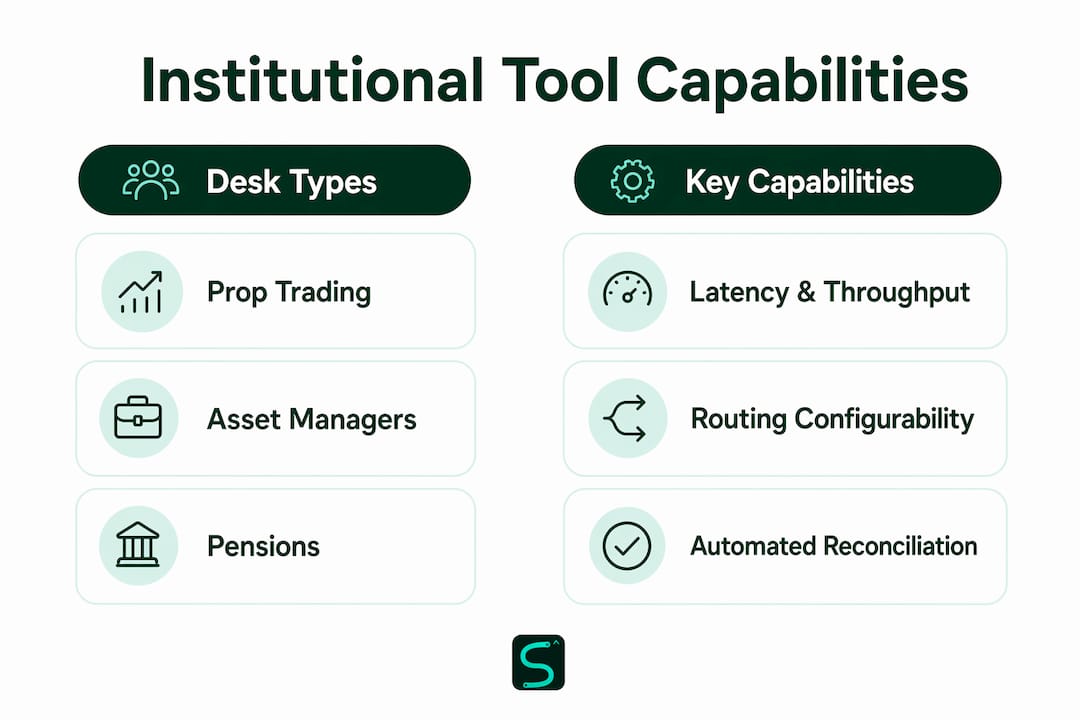
The operational definition centers on three things: system-of-record behavior, multi-user workflows, and compliance as a first-class capability. A platform earns the label when it generates on-demand best-execution reports, maintains immutable audit logs, and supports role-based permissions without requiring engineering intervention for every compliance request.
Characteristics that distinguish institutional-grade tools from retail platforms:
- Audit trails: Immutable, timestamped records of every order, modification, and cancellation
- FIX/API-first connectivity: FIX protocol support is a procurement precondition, not a nice-to-have
- Role-based permissions: Desk head, trader, ops, and compliance each see and control only what their role permits
- SLA-backed performance: Uptime and latency commitments are contractual, not aspirational
- PMS/custody integration: Native connectivity to portfolio management and custody systems
- Configurable retention policies: Data retention aligned to U.S. broker-dealer recordkeeping standards
The label only matters when the system demonstrably supports these workflows. A platform with a polished UI and institutional pricing that cannot export an audit log or configure routing logic fails the test. Price and appearance are irrelevant. Function is everything.
How does institutional architecture differ from retail platforms?
The defining trait of institutional infrastructure is not speed alone. It is the architectural foundation that prevents degradation when order volumes spike and quote volatility surges. Retail platforms are built for single-user order entry. Institutional stacks are built to stay stable when everything else is breaking.

Institutional infrastructure uses distributed processing, load balancing, and redundancy at every layer: liquidity provider, server, and network. Smart order routing (SOR) aggregates across multiple liquidity providers simultaneously, so a single LP failure does not interrupt execution. Active failover means the system switches to a backup path in microseconds, not minutes.
Key architectural differences at a glance:
- Distributed processing: Workloads split across nodes so no single point of failure can halt execution
- Liquidity aggregation: Multiple LP connections run in parallel; best price is selected in real time
- Smart order routing: Configurable routing logic directs orders based on price, size, and venue priority
- Active failover: Redundant LP, server, and network paths with automatic switchover
- Co-location: Servers physically placed near exchange matching engines to minimize round-trip latency
Volatility spike scenario: During a flash event, a retail platform routed through a single LP sees the LP pause quoting. Orders queue or reject. An institutional stack with active failover routes instantly to the next LP in the aggregation pool, preserving fill quality while the primary LP recovers. The desk sees a brief latency tick. The retail trader sees a missed fill.
On throughput, institutional performance targets include sub-millisecond FIX order submission and sustained message processing measured in millions of messages per second. Those numbers are not marketing. They remove the platform as an operational bottleneck during high-frequency periods.
Pro Tip: When a vendor claims sub-millisecond latency, ask for order-level monitoring metrics, not session summaries. Session averages mask tail latency events that matter most during volatility spikes. Request a histogram of order-submission times across a recent high-volume session.
What capabilities should institutional tools actually include?
Features matter when they solve a specific operational problem. Here is a checklist organized by functional area, with the business impact for each.
Connectivity
- FIX protocol: Required for integration with prime brokers, ECNs, and execution venues; absence is a hard disqualifier
- REST and WebSocket APIs: Modern fallbacks for web-based dashboards, mobile monitoring, and custom integrations
- Multi-venue routing: Connects to multiple execution venues; critical for best-execution obligations
Execution
- Smart order routing (SOR): Reduces slippage by selecting the best available price across venues at the moment of submission
- Algorithmic execution engines: VWAP, TWAP, implementation shortfall, and custom algos for minimizing market impact on large orders
- Pre-trade risk controls: Hard limits on order size, notional exposure, and position concentration before an order leaves the OMS
Data
- Level 2 / full order book depth: Necessary for accurate market-impact modeling and algo parameter tuning
- Order-level telemetry: Real-time monitoring of individual order states, not just position summaries
- Proprietary and alternative feeds: Institutional advantages include proprietary research feeds and ultra-low latency data infrastructure unavailable on retail tiers
Risk and compliance
- Pre-trade checks: Automated breach detection against risk limits before execution
- Immutable audit logs: Every order event captured with timestamp, user ID, and routing path
- Best-execution documentation: On-demand venue-fill reports and decision trails for regulatory review
Post-trade
- Automated reconciliation: Institutional stacks provide real-time reconciliation, break assignment, and resolution workflows; retail platforms rely on daily CSV exports
- Multi-account allocation: Allocate fills across accounts or funds automatically at execution time
- Execution-quality review: Post-trade analytics comparing achieved price to arrival price, VWAP, or benchmark
Desk-type mapping: Prop desks prioritize latency, throughput, and SOR configurability. Asset managers and pensions need allocation workflows and audit exports. Sell-side brokers require liquidity aggregation and regulatory reporting. The feature set is the same; the priority order shifts by desk type.
What security and compliance controls should you expect?
Compliance is not a module you add later. Platforms that treat it as a first-class capability reduce long-term operational overhead by embedding auditability and report generation into the core system. Procurement teams at U.S. broker-dealers and registered investment advisers should treat the following as baseline requirements, not differentiators.
Expected certifications and controls:
- SOC 2 Type II: Confirms the vendor's security controls have been independently audited over a sustained period, not just at a point in time
- ISO 27001: International information security management standard; signals systematic risk management across the vendor's organization
- Encryption in transit and at rest: TLS 1.2+ for data in motion; AES-256 or equivalent for stored data
- Immutable audit logs: Write-once records that cannot be altered or deleted by any user, including administrators
- Configurable data retention: Policies that align to SEC Rule 17a-4 and FINRA recordkeeping requirements for U.S. broker-dealers
- AML/KYT integration: For digital asset desks, native connectivity to AML and Know Your Transaction screening providers
Governance features to verify:
- Role-based access control (RBAC) with granular permission sets per user type
- Four-eyes approval workflows for large orders or parameter changes
- Exportable audit logs in machine-readable formats (CSV, JSON) without engineering support
- Configurable alert thresholds for compliance monitoring
What an honest compliance demo looks like: Ask the vendor to retrieve a best-execution report for a specific order from 90 days ago, live, during the demo. Then ask them to export the full audit log for that session. If either request requires a support ticket or engineering involvement, the platform does not meet institutional compliance standards regardless of what the sales deck says.
For U.S. desks, recordkeeping behaviors that support best-execution documentation are operational requirements under Regulation NMS and FINRA Rule 5310. They are not optional. A platform that cannot produce this documentation on demand creates regulatory exposure every day it is in production. Readers should confirm current requirements with a qualified compliance professional for their specific registration type.
How do institutional tools improve execution quality and reduce operational risk?
The benefits of high-grade tools show up in three places: execution quality, volatility resilience, and reduced operational overhead. Each connects directly to P&L and compliance outcomes.

Execution quality comes from routing logic, liquidity aggregation, and algorithm selection working together. SOR selects the best available price across venues at the moment of submission. Algorithms like VWAP and implementation shortfall break large orders into child orders sized to minimize market impact. The result is tighter fills relative to arrival price, particularly on orders large enough to move the market.
Volatility resilience is where the architectural differences from the previous section become P&L events. When a retail platform's single LP pauses quoting during a spike, the desk either misses the fill or takes a worse price. An institutional stack with active failover and multi-LP aggregation routes around the failure automatically. The volatility trading advantages of institutional infrastructure are not theoretical; they are the difference between executing at the intended price and chasing a moving market.
Operational risk reduction is the quieter benefit. Automated reconciliation eliminates the daily manual review cycle. Searchable audit trails cut the time to respond to a compliance inquiry from days to minutes. Automated compliance reporting removes the human error risk from a process that currently runs on spreadsheets at many mid-size desks.
Pro Tip: To test a vendor's resilience claims, request historical SLA reports covering the last 12 months, at least two incident post-mortems from high-volatility sessions, and access to their real-time monitoring dashboard during a live demo. Vendors with genuine institutional infrastructure welcome this request. Those without it deflect.
Which firm types actually need institutional-grade tools?
Not every desk needs the full institutional stack. The question is whether your current workflow is creating operational or compliance risk. Here is a practical map.
Use cases that require institutional-grade capabilities:
- Large-block execution where order size is material relative to venue liquidity
- Multi-account allocations across funds, separately managed accounts, or sub-advisers
- Agency trading mandates where best-execution documentation is a client obligation
- RFQ and prime-dealer flows requiring FIX connectivity and credit-limit management
- High-frequency or low-latency market making where microsecond routing decisions matter
- Multi-asset portfolio rebalancing with simultaneous equity, fixed income, and derivatives legs
- Custody-integrated digital asset trading requiring AML/KYT screening at execution time
Firm types mapped to primary needs:
- Hedge funds and prop desks: Latency, throughput, SOR configurability, and real-time risk monitoring
- Asset managers and pension funds: Allocation workflows, audit exports, and compliance reporting
- Sell-side brokers: Liquidity aggregation, regulatory reporting, and multi-client order management
Signs your current stack is failing:
- Spreads widen noticeably during stress events and fills deteriorate
- Post-trade reconstruction requires manual effort across multiple systems
- Compliance cannot produce a best-execution report without engineering support
- Reconciliation breaks appear regularly and take hours to resolve
- Role-based access is managed through workarounds rather than native permissions
If three or more of those signs apply, the cost of staying on a retail or semi-institutional platform is already showing up in your operations.
What does institutional tool implementation actually cost and how long does it take?
Pricing and deployment models vary, but the shapes are predictable. Understanding them before an RFP saves significant negotiation time.
Pricing models:
- Subscription SaaS (multi-tenant): Lowest entry cost, fastest deployment, shared infrastructure; suitable for desks where data residency is not a constraint
- Single-tenant hosted: Dedicated infrastructure in the vendor's cloud; higher cost, better isolation, preferred by desks with data residency or security requirements
- Self-hosted licensing: Maximum control and data residency; highest total cost of ownership due to internal infrastructure and support requirements
Deployment and data residency: U.S. broker-dealers operating under SEC and FINRA oversight should confirm that the vendor's deployment model supports data residency within the United States and aligns with their data governance policies. Multi-tenant SaaS vendors may store data across regions by default; confirm this in writing before signing.
Implementation benchmark: API-first systems with FIX support typically implement in 4–12 weeks. Timelines beyond 16 weeks usually indicate scope gaps discovered during UAT, not engineering complexity. If a vendor's initial estimate exceeds 16 weeks for a standard FIX integration, ask specifically what is driving the timeline before proceeding.
Cost drivers checklist:
- Number of FIX sessions and connectivity to prime brokers or ECNs
- Integration depth with existing PMS and custody systems
- Custom routing logic or proprietary algorithm development
- Implementation support tier (self-serve vs. dedicated implementation team)
- Ongoing support SLA level (business hours vs. 24/7 with named contacts)
Total cost of ownership vs. vendor fees: The visible subscription or license fee is rarely the largest cost. Factor in internal engineering time for integration, ongoing ops overhead for manual processes the platform does not automate, and the compliance cost of gaps in audit capability. A platform that automates reconciliation and compliance reporting often pays for the cost difference within the first year of operation.
How do you evaluate institutional tool vendors effectively?
Run a structured evaluation. A scripted demo with a reproducible scenario reveals more than any sales presentation.
Must-have capabilities checklist
- FIX protocol support with documented session configuration
- Order-level audit logs exportable without engineering support
- Configurable SOR with documented routing logic (not black-box)
- Pre-trade risk controls with hard limits and breach alerting
- SLA documentation with uptime targets and penalty terms
- SOC 2 Type II or ISO 27001 certification (current, not expired)
- Role-based access control with granular permission sets
- Post-trade reconciliation and break management workflows
- Data retention policies aligned to U.S. regulatory requirements
- Staging environment available for UAT before production go-live
Questions to ask by role
Desk head / trader: What is the p99 order-submission latency during peak volume? Can we configure routing priority by venue and time of day? What algos are available and are parameters adjustable?
Operations: How are reconciliation breaks surfaced and assigned? What does the break resolution workflow look like? Can we schedule automated end-of-day reports?
Compliance: Can you retrieve a best-execution report for a specific order from 90 days ago, right now? What is the retention period for audit logs and in what format are they exported?
Engineering: What is the FIX specification version and where is the session configuration documentation? What are the REST and WebSocket API rate limits? What deployment options are available and what does the infrastructure diagram look like?
Red flags to watch for
- Opaque routing logic with no documentation or configurability
- No FIX support or undocumented integration paths
- Audit log export requires a support ticket or engineering work
- SLA language uses "commercially reasonable efforts" without defined uptime targets
- Incident post-mortems from the last 12 months are unavailable or heavily redacted
- Staging environment access requires a separate paid engagement
Routing configurability is a hard requirement. Black-box routing fails institutional audit for best-execution questions. If the vendor cannot show you the routing logic and explain how it selects venues, that is a disqualifier regardless of how the rest of the demo goes.
The recommended evaluation process: run a scripted demo using a reproducible order scenario, request staging environment access for a two-week UAT, and use a checklist-driven UAT that includes live compliance reporting retrieval. Score each vendor against the must-have list before any commercial discussion.
How does Scalping-algo map to the institutional checklist?
Scalping-algo is a TradingView indicator platform built for short-term scalping across crypto, forex, indices, commodities, and futures. Its architecture and feature set align with several institutional requirements, particularly around transparency, reproducibility, and execution workflow integration.
Key features mapped to institutional requirements:
| Feature | Operational need | Evidence |
|---|---|---|
| Open-source Pine Script v6 indicators | Auditability and reproducibility | Scripts are publicly inspectable; methodology is verifiable, not black-box |
| Non-repainting buy/sell signals | Signal integrity and backtesting validity | Historical signals do not change; backtest results are reproducible |
| Backtesting dashboard | Methodology validation | Traders can verify strategy performance before live deployment |
| Webhook alerts to Discord | Execution workflow integration | Alerts route directly to execution channels without manual monitoring |
| Volatility gating | Pre-trade risk control | Filters signals during adverse volatility conditions before entry |
| Command Center dashboard | Observability and monitoring | Centralizes alerts, signals, and performance data in one interface |
| Multi-timeframe confluence | Signal quality and false-positive reduction | Confirms signals across timeframes before triggering an alert |
Implementation steps for integrating Scalping-algo into an execution flow:
- Staging setup: Add indicators to a TradingView paper-trading account and configure alert conditions
- Webhook wiring: Connect TradingView alerts to a Discord channel or execution webhook endpoint
- Backtest validation: Run the backtesting dashboard against recent historical data to confirm signal behavior
- Parameter calibration: Adjust volatility gating thresholds and confluence filters to match the target instrument and timeframe
- Live monitoring: Use the Command Center to monitor signal frequency, alert delivery, and execution outcomes in real time
The open-source approach directly supports the auditability standard that institutional and professional workflows require. Platforms that prioritize reproducibility and transparent methodology produce more defensible research and operational outcomes. When every indicator's logic is publicly readable in Pine Script v6, there is no black-box routing problem. Any trader, compliance officer, or counterparty can verify exactly how a signal was generated.
On transparency as an institutional signal: Open-source scripts are not just a developer convenience. They are an audit trail for signal generation. When a compliance question arises about why a trade was entered, an open-source indicator provides a complete, reproducible answer. That is the same standard institutional stacks apply to order routing logic.
For traders looking to understand how these tools provide an execution edge for scalpers, the combination of non-repainting signals, volatility gating, and webhook-driven execution covers the core institutional requirements at the indicator layer.
Key Takeaways
Institutional-grade tools are worth the investment when your desk requires auditability, multi-user controls, and execution resilience that retail platforms cannot provide under stress.
| Point | Details |
|---|---|
| Architecture is the differentiator | Distributed processing, multi-LP aggregation, and active failover separate institutional from retail platforms. |
| Compliance is non-optional | SOC 2 Type II, immutable audit logs, and on-demand best-execution reports are baseline requirements for U.S. desks. |
| Implementation benchmark | API-first systems with FIX support typically implement in 4–12 weeks; timelines beyond 16 weeks signal scope gaps. |
| Evaluate with a scripted demo | Request order-level audit log export and a live best-execution report retrieval during every vendor demo. |
| Scalping-algo for indicator-layer needs | Open-source Pine Script v6 indicators, backtesting dashboard, and webhook alerts address transparency and execution workflow requirements. |
The procurement mistake most desks keep making
Most desks evaluate institutional tools the wrong way. They compare feature lists and pricing tiers, pick the platform with the most checkboxes, and sign a contract before running a single scripted scenario in staging. Then they discover the audit log export requires a support ticket, the SOR logic is undocumented, and the reconciliation workflow is a CSV download with a different column order than their PMS expects.
The checklist in this article exists because those gaps are predictable. Every one of them surfaces in UAT if you run a proper scripted evaluation. The desks that skip staging to save two weeks end up spending two months on post-go-live remediation.
At Scalping-algo, the open-source approach to indicator development reflects the same principle: nothing should be hidden from the trader using the tool. Transparent methodology, reproducible backtests, and configurable parameters are not features. They are the minimum standard for any tool a professional desk should trust. The risk management checklist framework applies at every layer of the stack, from order routing to signal generation.
The desks that get this right share one habit: they evaluate tools the way they evaluate trades. They define the criteria before they look at the options, they test in a controlled environment, and they do not go live until the results are reproducible.
Scalping-algo: institutional-grade indicators for active traders
Professional execution starts at the signal layer. Scalping-algo provides premium TradingView indicators built in Pine Script v6 with open-source transparency, non-repainting signals, and native webhook execution alerts — the features that matter most when you need reproducible, auditable entries and exits.
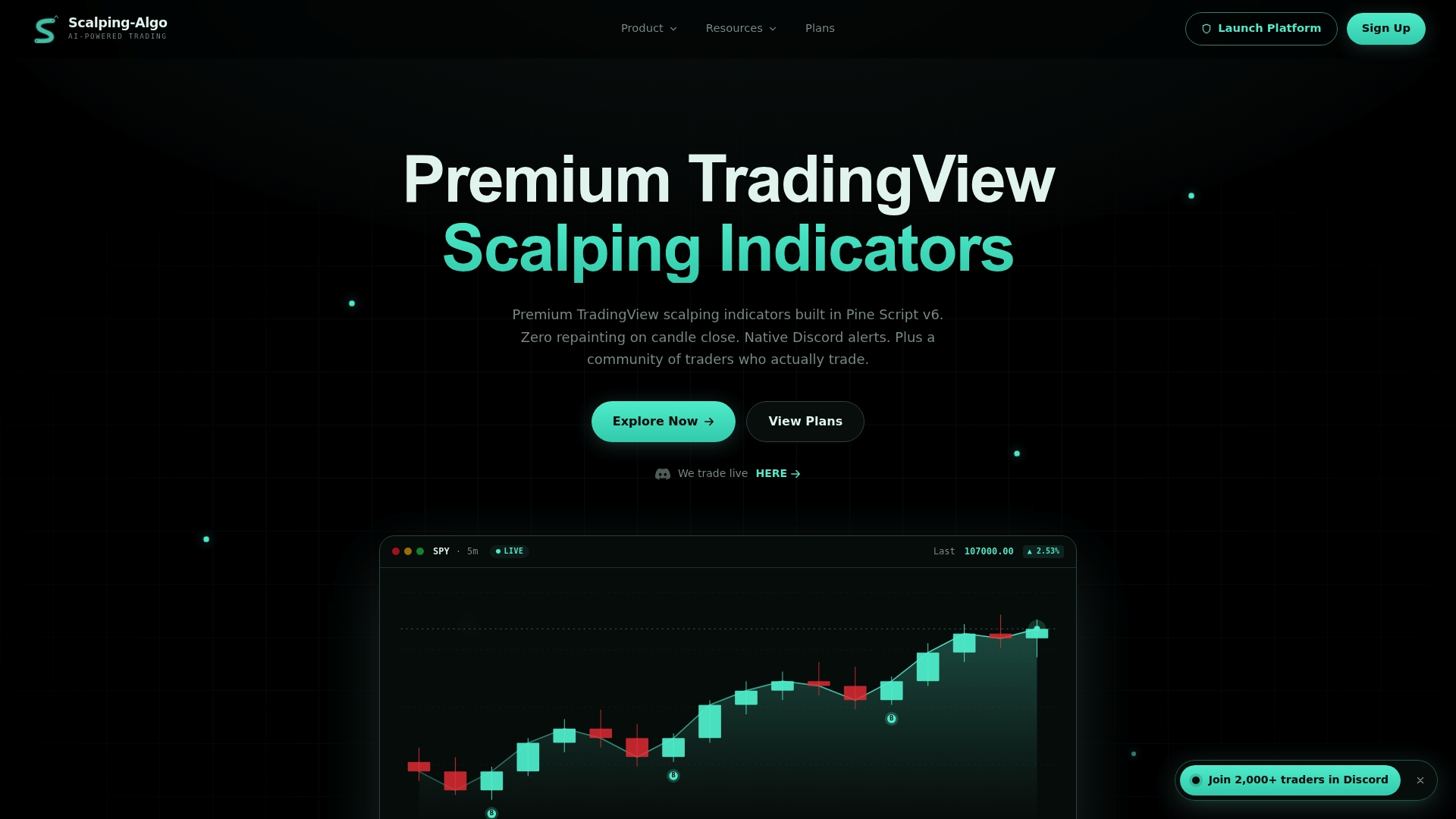
The platform covers crypto, forex, indices, commodities, options, and futures across lower timeframes (1m–15m), with volatility gating and multi-timeframe confluence built in. Every indicator's logic is publicly readable. Every backtest is reproducible. Alerts route directly to Discord or your execution endpoint without manual monitoring.
Next steps:
- Review the full indicator suite and subscription options at scalping-algo.com
- Explore the 3-indicator execution workflow to see how the system integrates into a live trading flow
- Connect with the mentorship community for implementation support and live trading sessions
Useful sources for procurement and technical validation
- Institutional trading infrastructure: the foundation of modern market performance — Covers distributed processing, latency targets, and redundancy design; useful for engineering teams validating architecture claims.
- Institutional Trading Tools vs Retail Platforms — Explains the architectural and operational gap between retail and institutional stacks; good background for procurement teams new to institutional evaluation.
- Institutional Digital Asset Trading Stack: Criteria — Detailed criteria for institutional digital asset platforms including compliance, SLA, and implementation benchmarks; directly applicable to vendor RFPs.
- What Is an Institutional Trading Platform? — Explains post-trade workflow differences and system-of-record requirements; useful for ops and compliance teams building evaluation criteria.
- cTrader risk management tools for prop traders — Practical checklist of execution and risk controls for prop desks; useful for comparing feature requirements against a real-world implementation.
- Institutional trading tools: The scalper's real edge — Explains how institutional-grade tools provide an execution edge specifically for short-term and scalping strategies.
- Indicators for institutional traders: 2026 guide — Covers indicator selection and configuration for professional trading desks; relevant for teams evaluating signal-layer tools.
- Top benefits of algorithmic trading for scalpers — Explores how algorithmic execution benefits apply at the desk level; useful for evaluating algo engine requirements.